
Dinumma
Walker, 1858
Species Guides
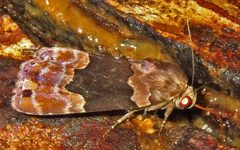
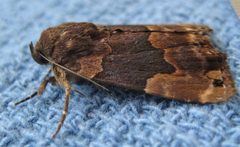
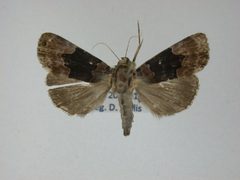
1- Dinumma deponens(curved-ribbon)
Dinumma is a of in the Erebidae, established by Francis Walker in 1858. The genus contains approximately 11 described distributed across South and Southeast Asia, with one species introduced to North America. exhibit characteristic wing venation and palp structure typical of the Calpinae. Larvae of at least one species demonstrate unusual aquatic locomotion .
Pronunciation
How to pronounce Dinumma: /dɪˈnʊmə/
These audio files are automatically generated. While they are not always 100% accurate, they are a good starting point.
Identification
Forewings with nearly even width and rounded apex/outer margin distinguish Dinumma from related Calpinae with more angular or tapering forewings. Hindwing venation with 5 from lower angle is diagnostic. Smoothly scaled palpi and separate it from with rougher scaling. -level identification requires examination of genitalia and geographic locality.
Images
Habitat
Terrestrial; occur in forested and wooded . Larvae feed on plants growing along wetland edges and other vegetation zones. At least one has been documented on pond water surfaces due to accidental fall from overhanging vegetation.
Distribution
Native range: India, Thailand, China, Japan, Korea, Sri Lanka, Sundaland (Malay Peninsula, Sumatra, Borneo), Philippines, Sulawesi, New Guinea. Introduced: United States (Dinumma deponens).
Diet
Larvae of Dinumma deponens feed on leaves of Albizia julibrissin (Fabaceae). Diet of other within the is not documented.
Host Associations
- Albizia julibrissin - larval plantFabaceae; documented for D. deponens only
Behavior
Larvae of Dinumma deponens exhibit undulatory locomotion on water surfaces, swinging their bodies rapidly from side to side to propel forward. This uses abdominal movements rather than thoracic legs and has been observed to aid escape from drowning and aquatic such as water striders.
Ecological Role
Larvae serve as prey for aquatic including water striders when on water surfaces. Potential prey resource for fish. Herbivorous larvae consume foliage of plants.
Human Relevance
Dinumma deponens has been introduced to the United States, presumably via human transport. No significant economic or medical importance documented.
Similar Taxa
More Details
Aquatic larval behavior
The undulatory swimming in D. deponens larvae represents an unusual for a primarily terrestrial , allowing survival after accidental immersion.
Taxonomic history
Walker described the in 1858 based on D. deponens from India; several were later transferred from other genera.