
Hypsoropha hormos
Hübner, 1818
Small Necklace Moth
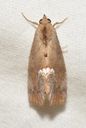
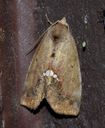
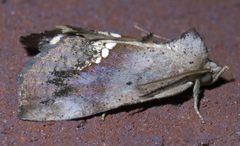
Hypsoropha hormos, the small necklace , is a moth in the Erebidae. display a distinctive pattern of white spots forming a necklace-like band across brown wings. The species is found in the southeastern United States and has been documented feeding on persimmon. It is double-brooded, with adults active from February through October, peaking from April to August.
Pronunciation
How to pronounce Hypsoropha hormos: /hɪpˈsɔrəfə ˈhɔrmɔs/
These audio files are automatically generated. While they are not always 100% accurate, they are a good starting point.
Identification
Distinguished from the large necklace moth (Hypsoropha monilis) by its smaller size; both share the characteristic necklace pattern of white spots across the wings. The two species have broadly overlapping ranges, making size the primary distinguishing feature in the field.
Images
Appearance
wings are brown with a postmedial band of white spots that meet at the inner margins, forming a necklace-like pattern. The is smaller than the closely related Hypsoropha monilis.
Distribution
Southeastern United States, from Texas and Kansas westward to Florida and New Jersey eastward. Documented in Alexandria County, Virginia.
Seasonality
active February to October, with peak activity from April to August.
Host Associations
- persimmon - larval Documented in Alexandria County, Virginia
Life Cycle
Double-brooded. are less than hemispherical, domed, with approximately 48 ribs around the margin; diameter 0.6 mm. Rib height diminishes by confluence in pairs toward the vertex.
Similar Taxa
- Hypsoropha monilisLarger size; shares necklace pattern of white spots and overlapping range