
Hypenopsis macula
(Druce, 1891)
Black-spotted Schrankia
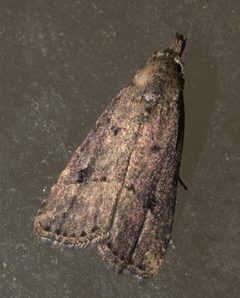
Hypenopsis macula, commonly known as the black-spotted schrankia , is a small erebid moth found across much of North America and into Central America. The was first described by Herbert Druce in 1891 under the name Schrankia macula, and has since been reclassified to the Hypenopsis. It occurs in a broad range of from the eastern United States through the Southwest and into Mexico and Central America.
Pronunciation
How to pronounce Hypenopsis macula: //haɪˈpɛnəpˌsɪs ˈmækjʊlə//
These audio files are automatically generated. While they are not always 100% accurate, they are a good starting point.
Identification
The specific epithet "macula" (meaning spot) suggests the presence of a distinct dark marking, likely on the forewings, though detailed diagnostic features are not well documented in available sources. As a member of the Hypenopsis, it is presumably small-bodied with relatively narrow wings typical of many erebid in this group.
Images
Habitat
Occurs in diverse environments across its broad range, including deciduous and mixed forests, scrublands, and suburban areas. Documented from states spanning humid southeastern regions to arid southwestern deserts, indicating considerable ecological flexibility.
Distribution
North America: Alabama, Arizona, California, Florida, Georgia, Indiana, Louisiana, Maryland, Massachusetts, Mississippi, Missouri, North Carolina, Oklahoma, South Carolina, Tennessee, Texas, and Virginia. Extends south through Mexico into Central America.
More Details
Taxonomic Note
Originally described as Schrankia macula Druce, 1891, this has been transferred to the Hypenopsis. The genus Schrankia remains distinct but closely related, and some sources may still list this species under the older combination.
Sources and further reading
- BugGuide
- iNaturalist taxon
- Be careful around baldfaced hornets, Dolichovespula maculata — Bug of the Week
- An inside look at baldfaced hornets, Dolichovespula maculata — Bug of the Week
- Paper nests here and there: Baldfaced hornets, Dolichovespula maculata, and tropical nest builders, Polybia spp. — Bug of the Week
- High fiber diets for baldfaced hornets? Nah, construction materials for enlarging nests: Baldfaced hornets, Dolichovespula maculata — Bug of the Week
- What do insects do in winter, Part 2? Tolerating the big chill: Banded woolly bears, Pyrrharctia isabella, field crickets, Gryllus spp., baldfaced hornets, Dolichovespula maculata, and others — Bug of the Week
- Cicindela denverensis – green claybank tiger beetle | Beetles In The Bush