
Drasteria parallela
Crabo & Mustelin, 2013
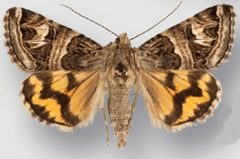
Drasteria parallela is a noctuid in the Erebidae, described in 2013 by Crabo and Mustelin. The is to the Pacific Northwest and northern California, restricted to middle-elevation forest on exposed ridges. are active in July and exhibit distinctive forewing patterns with parallel lines across a pale medial area, which inspired the species name.
Pronunciation
How to pronounce Drasteria parallela: //dræsˈtɛɹiə pəˈɹælɛlə//
These audio files are automatically generated. While they are not always 100% accurate, they are a good starting point.
Identification
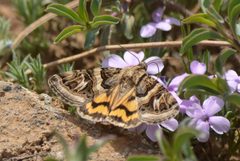
Distinguished from by parallel lines across the pale medial area of the forewing, a trait referenced in both the name and etymology. The combination of dark brown basal and subterminal forewing areas with light tan medial band, plus the dull orange hindwing with gray basal suffusion, separates it from related species Drasteria divergens and Drasteria convergens.
Images
Habitat
Exposed ridges in forests at middle elevations
Distribution
Cascade Mountains of Washington; Klamath and Siskiyou Mountains of southwestern Oregon; northern Sierra Nevada in California
Seasonality
on wing in July
Similar Taxa
- Drasteria divergensRelated with geometry-referenced name; D. parallela named to perpetuate this naming pattern
- Drasteria convergensRelated with geometry-referenced name; D. parallela named to perpetuate this naming pattern
- Drasteria mirifica with similar startle defense using brightly-colored hindwings, though D. parallela's specific defense unconfirmed
More Details
Etymology
The specific epithet 'parallela' refers to the parallel lines across the pale medial area of the forewing, continuing the geometric naming convention established by related Drasteria divergens and Drasteria convergens
Sources and further reading
- BugGuide
- Wikipedia
- GBIF taxonomy match
- iNaturalist taxon
- NCBI Taxonomy
- UC Davis Scientist Spotlighted in 'Antenna' | Bug Squad
- Walter Leal: The Energizer Bunny at Full-Industrial Strength | Bug Squad
- Cyclocephala parallela Archives - Entomology Today
- JIPM Article on Masked Chafer Grubs in Turfgrass Explains Management Techniques
- Bug Eric: National Moth Week Recap for Colorado Springs