
Catocala palaeogama
Guenée, 1852
Oldwife Underwing, Old Wife Underwing
Catocala palaeogama is a North American underwing in the Erebidae, first described by Guenée in 1852. The exhibits the characteristic underwing : cryptic forewings that conceal brightly patterned hindwings when at rest. are active from June through October with one per year. The larval stage feeds exclusively on hardwood trees in the walnut and hickory family (Juglandaceae), as well as chestnut, apple, and related species. The species ranges across eastern and central North America from Ontario to South Carolina and west to Arkansas and Oklahoma.

Pronunciation
How to pronounce Catocala palaeogama: /kəˈtɒkələ pæliːəˈɡeɪmə/
These audio files are automatically generated. While they are not always 100% accurate, they are a good starting point.
Identification
The Oldwife Underwing can be distinguished from similar Catocala by the specific pattern of its hindwing bands and the details of forewing markings. Some authors consider C. palaeogama synonymous with C. neogama, indicating close morphological similarity between these . Accurate identification often requires examination of genitalic characters or comparison with reference specimens. The species is larger than many microlepidoptera but comparable in size to other underwing moths. The combination of geographic range, plant association with Juglandaceae, and period (June–October) aids in field identification.
Images
Appearance
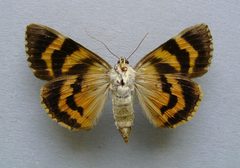
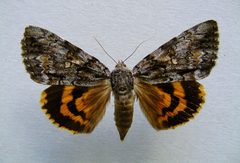
have a wingspan of 60–70 mm. The forewings are gray-brown with intricate dark patterning, providing bark-like camouflage when the is at rest with wings folded roof-like over the body. The hindwings, concealed at rest, display bold coloration typical of underwing moths—bands of orange, red, black, and white that are flashed suddenly when the moth is disturbed. The specific pattern elements of the hindwings distinguish it from .
Habitat
Deciduous forest and woodland containing trees, particularly areas with hickory, walnut, and chestnut. The occupies mature hardwood forests and mixed woodlands where larval food plants are abundant.
Distribution
Eastern and central North America: Ontario and Quebec (rare), Maine, New Jersey, Tennessee, South Carolina, west to Arkansas and Oklahoma, north through Iowa, Indiana, Illinois, and Michigan.
Seasonality
are on wing from June to October depending on location. One per year is probable.
Diet
Larvae feed on Carya alba, C. glabra, C. illinoinensis, C. laciniosa, C. ovalis, C. ovata (hickories), Castanea dentata (American chestnut), Juglans nigra (black walnut), and Malus pumila (apple). feeding habits are not documented in available sources.
Host Associations
- Carya alba - larval food plant
- Carya glabra - larval food plant
- Carya illinoinensis - larval food plant
- Carya laciniosa - larval food plant
- Carya ovalis - larval food plant
- Carya ovata - larval food plant
- Castanea dentata - larval food plant
- Juglans nigra - larval food plant
- Malus pumila - larval food plant
Life Cycle
One per year is probable. emerge June through October. Larval stage feeds on tree foliage. presumably occurs in soil or leaf litter, though specific details of pupal stage are not documented in available sources.
Behavior
are and attracted to light, though underwing moths typically remain on the periphery of light stations rather than landing directly on sheets. When disturbed, adults flash their brightly colored hindwings as a startle defense against , then rapidly fly to a new perch where they resume cryptic posture with hindwings concealed.
Ecological Role
Larvae function as folivores on hardwood trees, contributing to nutrient cycling in forest . may serve as prey for including bats and birds. The is part of the diverse underwing that contributes to overall Lepidoptera biodiversity in eastern North American forests.
Human Relevance
The is of interest to lepidopterists and citizen scientists participating in observation events such as National Moth Week. Its larvae feed on commercially important nut trees (pecan, hickory, walnut) and apple, though it is not documented as a significant agricultural pest. Taxonomic uncertainty regarding its relationship to C. neogama affects conservation and inventory efforts.
Similar Taxa
- Catocala neogamaSome authors consider C. palaeogama synonymous with C. neogama, indicating extremely close morphological similarity requiring detailed examination to distinguish.
More Details
Taxonomic Status
The relationship between Catocala palaeogama and C. neogama remains unresolved, with some authorities treating them as distinct and others as synonyms. This uncertainty complicates distribution mapping and conservation assessment.
Conservation Status
Considered rare in Ontario and Quebec at the northern extent of its range. trends are poorly documented across most of its distribution.
Sources and further reading
- BugGuide
- Wikipedia
- GBIF taxonomy match
- iNaturalist taxon
- NCBI Taxonomy
- Catalogue of Life
- A Gathering of Lepidopterists: Who's Who of the Butterfly, Moth Experts | Bug Squad
- Got Moths? Celebrate National Moth Week and Global Citizen Science
- Bug Eric: National Moth Week Recap, 2015
- Bug Eric: National Moth Week Recap for Colorado Springs
- Bug Eric: National Moth Week 2024 Recap from Kansas City
- Bug Eric: New Mexico Night Bugs