
Catocala neogama
(Smith, 1797)
Bride, Bride Underwing
Species Guides
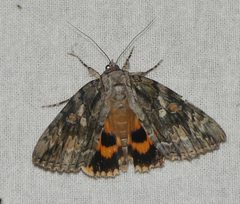
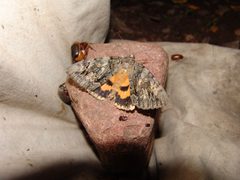
1A large underwing with striking orange and black hindwings, found across eastern North America. are attracted to ultraviolet light. The exhibits geographic variation in size and coloration, with a distinct western (C. n. euphemia) adapted to semiarid conditions. Caterpillars feed exclusively on walnut and hickory trees.
Pronunciation
How to pronounce Catocala neogama: /ˌkætəˈkɑːlə ˌniːoʊˈɡeɪmə/
These audio files are automatically generated. While they are not always 100% accurate, they are a good starting point.
Identification
Distinguished from the similar Old Wife Underwing (Catocala palaeogama) by less densely hairy hindwing bases (hairs only above, not below), more scalloped and less angular orange/black border on hindwing upperside, and larger size with minimal wingspan overlap. The western C. n. euphemia is larger and paler than eastern .
Images
Appearance
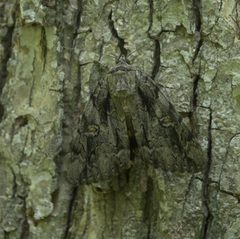
Wingspan 70–85 mm (nominate ), up to 90 mm for C. n. euphemia. Forewings brownish gray, evenly dark or with darker center; paler and browner in aridland , darker gray with brown markings in eastern populations. Hindwings orange with roughly concentric black markings: dense dark hairs at base creating brownish or reddish appearance; black band through center from leading to trailing edge; wider black band near termen with irregular scalloped border; outer rim lighter yellow. Undersides pale yellowish orange with black bands. Legs spiny: foreleg and hindleg tibiae spiny, with four rows of irregular spines.
Habitat
Deciduous forests and woodlands containing trees; semiarid regions of the Colorado Plateau for euphemia.
Distribution
North America east of the Rocky Mountains, from Maine and Quebec south to northern Florida, west to South Dakota, New Mexico, Arizona, and Texas. Western C. n. euphemia occurs in Arizona and New Mexico.
Seasonality
active June to October (nominate ); July to August (C. n. euphemia).
Diet
Caterpillars feed on Juglandaceae: Juglans (walnut) including butternut (J. cinerea) and Arizona black walnut (J. major), and Carya (hickories). Western appear restricted to Juglans, as Carya is rare or absent in their range.
Life Cycle
Complete with , larval, pupal, and stages. Caterpillars feed on tree foliage.
Behavior
, attracted to ultraviolet light.
Ecological Role
Herbivore; caterpillars are folivores on walnut and hickory trees.
Human Relevance
Occasional subject of lepidopterological collecting and photography due to attractive hindwing pattern.
Similar Taxa
- Catocala palaeogamaMost similar ; distinguished by thicker hindwing hair covering (below and above), less scalloped hindwing border, smaller size