
Catocala ophelia
Edwards, H., 1880
Ophelia Underwing
Catocala ophelia is a in the Erebidae, commonly known as the Ophelia Underwing. It inhabits dry forests in the southwestern United States. are active from July to October with likely one per year. The exhibits the characteristic underwing pattern of dull forewings concealing brightly colored hindwings.
Pronunciation
How to pronounce Catocala ophelia: /ˌkætoʊˈkeɪlə əʊˈfiːliə/
These audio files are automatically generated. While they are not always 100% accurate, they are a good starting point.
Identification
Distinguished from other Catocala by geographic range and association with dry forests of Arizona, California, and southwestern Oregon. Specific wing patterns and markings require examination of specimens or high-quality images for definitive identification. Former C. ophelia dollii is now considered a synonym.
Images
Appearance
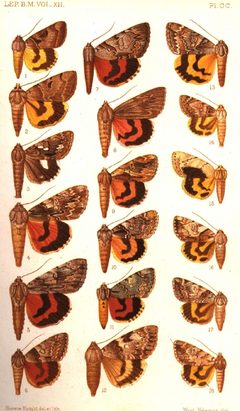
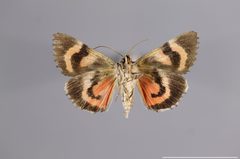
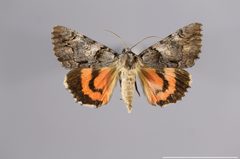
Wingspan approximately 52 mm. Forewings are cryptically colored in muted tones typical of underwing moths, serving as camouflage when at rest. Hindwings display the bold, colorful pattern characteristic of the Catocala, normally concealed beneath the forewings.
Habitat
Dry forests. Associated with oak given larval plant requirements.
Distribution
Southwestern United States: Arizona, California, and southwestern Oregon.
Seasonality
active July to October, varying by location. Likely one per year.
Diet
Larvae feed on Quercus macrocarpa (bur oak) and Quercus chrysolepis (canyon live oak). feeding habits not documented.
Host Associations
- Quercus macrocarpa - larval bur oak
- Quercus chrysolepis - larval canyon live oak
Life Cycle
Probably one per year. Complete with , larval, pupal, and stages. Specific details of site and stage not documented.
Behavior
. Attracted to light. Exhibits typical underwing of flashing brightly colored hindwings when disturbed, then settling with wings closed to resume cryptic appearance.
Ecological Role
Larval stage functions as herbivore on oak . likely serve as prey for including bats and birds. Specific ecological interactions not documented.
Human Relevance
Subject of interest to lepidopterists and enthusiasts. Participates in National Moth Week events as part of the charismatic underwing moth group. No documented economic or agricultural significance.
Similar Taxa
- Catocala verillianaOverlapping range and ; both found in southwestern dry forests. Requires examination of wing patterns for separation.
- Catocala aholibahSimilar size and preferences in western North America. Distinguished by specific hindwing coloration and pattern details.
- Other Catocala speciesMany underwing moths share similar cryptic forewing appearance; definitive identification requires comparison of hindwing patterns and geographic context.
More Details
Taxonomic History
Former Catocala ophelia dollii has been synonymized with the nominate form.
Conservation Status
Not evaluated; no conservation concerns documented in available sources.
Sources and further reading
- BugGuide
- Wikipedia
- GBIF taxonomy match
- iNaturalist taxon
- NCBI Taxonomy
- Catalogue of Life
- A Gathering of Lepidopterists: Who's Who of the Butterfly, Moth Experts | Bug Squad
- Got Moths? Celebrate National Moth Week and Global Citizen Science
- Bug Eric: National Moth Week Recap, 2015
- Bug Eric: National Moth Week Recap for Colorado Springs
- Bug Eric: National Moth Week 2024 Recap from Kansas City
- More “skulls on my desk” | Beetles In The Bush