
Euchaetes fusca
Rothschild, 1910
Euchaetes fusca is a in the Erebidae, first described by Rothschild in 1910. The is distributed from the southwestern United States through Central America to Rica. have a wingspan of approximately 34 mm. This species belongs to a whose larvae are known to feed on milkweeds and sequester cardiac glycosides for defense, though specific details for E. fusca itself remain poorly documented.
Pronunciation
How to pronounce Euchaetes fusca: //juːˈkeɪtiːz ˈfʌska//
These audio files are automatically generated. While they are not always 100% accurate, they are a good starting point.
Identification
Euchaetes fusca can be distinguished from other Euchaetes by its geographic distribution in the southwestern United States and Central America, combined with its relatively small wingspan. The species was originally described as Pygarctia fusca before transfer to Euchaetes. Accurate identification likely requires examination of genitalia or molecular analysis, as external appears similar to other small arctiine .
Images
Appearance
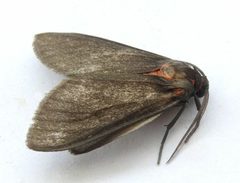
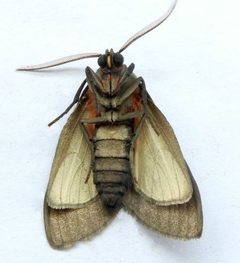
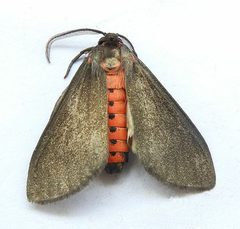
are relatively small with a wingspan of about 34 mm. The specific coloration and pattern of E. fusca are not well described in available sources, though typically exhibit muted brown or grayish forewings. Larvae are undescribed in published literature for this .
Distribution
Found from the southwestern United States (including California and Arizona) southward through Central America to Rica.
Similar Taxa
- Euchaetes egleA congeneric with similar size and ; E. egle is widely distributed in eastern and central North America and is well-known for its distinctive hairy orange-and-black caterpillars that feed on milkweeds. E. fusca occurs in the western and southwestern range where E. egle is absent or uncommon.
More Details
Sources and further reading
- BugGuide
- Wikipedia
- GBIF taxonomy match
- iNaturalist taxon
- NCBI Taxonomy
- Catalogue of Life
- Bugs in orange and black - Monarch butterfly, Danaus plexippus Milkweed Bug - Oncopeltus fasciatus; Milkweed tiger moth, Euchaetes egle — Bug of the Week
- Bugs in Orange and Black: Monarch Butterfly, Milkweed Leaf Beetle, Milkweed Bug, and Milkweed Tiger Moth — Bug of the Week
- Bug in orange and black: Milkweed tussock moth, Euchaetes egle, and its caterpillars have tricks but no treats for hungry predators — Bug of the Week
- The other monarch caterpillar: Milkweed tussock moth, Euchaetes egle — Bug of the Week
- Save some milkweed for me! Monarchs and the milkweed tussock moth, Euchaetes egle — Bug of the Week
- Tobacco Thrips: Tiny Insects With a Big Impact on Georgia Peanut Production