
Haploa
Hübner, 1820
haploa moths
Species Guides
6- Haploa clymene(Clymene Moth)
- Haploa colona(colona moth)
- Haploa confusa(confused haploa)
- Haploa contigua(Neighbor Moth)
- Haploa lecontei(Leconte's Haploa Moth)
- Haploa reversa(Reversed Haploa Moth)
Haploa is a of tiger moths in the Erebidae, erected by Jacob Hübner in 1820. The genus contains approximately six recognized distributed in North America, including the well-known Clymene (H. clymene) and the confused haploa moth (H. confusa). Larvae are generally , feeding on diverse plants across multiple families. The genus is characterized by distinctive caterpillar coloration and wing patterns that facilitate identification.
Pronunciation
How to pronounce Haploa: /ˈhæploʊə/
These audio files are automatically generated. While they are not always 100% accurate, they are a good starting point.
Identification
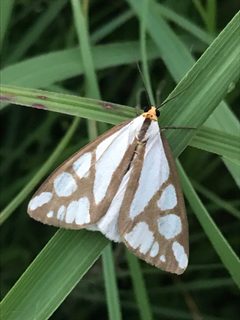
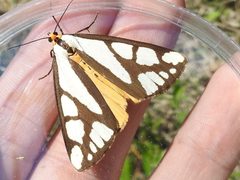
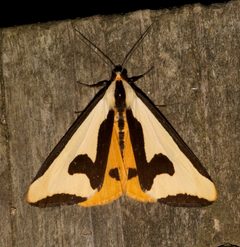
distinguished from other Arctiinae by forewing pattern geometry and color arrangement. H. clymene recognizable by cream-colored forewings with bold black markings forming a cross-like pattern. H. confusa has more mottled, less sharply defined patterns. Caterpillars identified by dark coloration with yellow longitudinal stripes and blue spotting; separation from other Haploa larvae requires plant association and geographic context. Similar tiger moth in Erebidae lack the specific pattern geometry and caterpillar color arrangement seen in Haploa.
Images
Habitat
Larvae found in diverse including prairies, woodlands, and riparian areas, reflecting feeding habits. associated with areas supporting larval plants. Specific habitat preferences vary by .
Distribution
North America; records from Vermont and throughout the United States. Individual have more restricted ranges within this broader distribution.
Seasonality
active during warmer months; exact varies by . Larvae observed in spring and summer. H. clymene caterpillars recorded in late summer and fall.
Diet
Larvae , feeding on plants including Populus, Salix, Prunus, Rubus, Penstemon digitalis, and Eupatorium serotinum. Specific host associations vary among .
Host Associations
- Populus - larval feeding record
- Salix - larval feeding record
- Prunus - larval feeding record
- Rubus - larval feeding record
- Penstemon digitalis - larval recorded for H. confusa
- Eupatorium serotinum - larval recorded for H. clymene
Life Cycle
Complete with , larva, pupa, and stages. Larval stage and externally feeding on foliage. likely occurs in leaf litter or soil, though specific details are not well documented.
Behavior
Caterpillars feed openly on foliage, suggesting aposematic defense against . are and attracted to light. No other specific are documented in available sources.
Ecological Role
Larvae function as herbivores across multiple plant . may serve as , though this has not been specifically documented. As members of the tiger moth , they likely participate in as prey for bats and other .
Human Relevance
H. clymene is a recognizable and frequently photographed due to its distinctive pattern. Caterpillars occasionally encountered by naturalists and gardeners. No significant economic impact documented.
Similar Taxa
- Other Arctiinae generaSimilar size and general tiger moth appearance, but differ in forewing pattern geometry and caterpillar coloration
- CtenuchaSome share bold patterning but differ in wing shape and caterpillar
More Details
Taxonomic History
Formerly classified in , now placed in Erebidae as Arctiinae following molecular phylogenetic revisions of Lepidoptera.
Species Diversity
The includes H. clymene, H. colona, H. confusa, H. contigua, H. lecontei, and H. reversa. identification often requires examination of genitalia or careful pattern analysis.