
Opostegidae
white eyecap moths, white eye-capped moths
Subfamily Guides
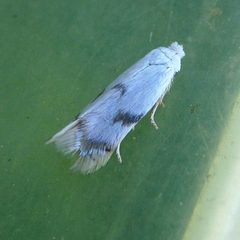
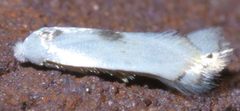
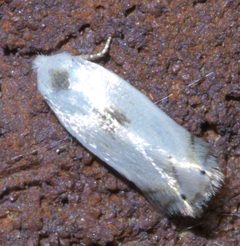
1A of minute distinguished by exceptionally large eyecaps covering the . The family comprises approximately 200 described across two (Oposteginae with 87 species, Opostegoidinae with 15 species), with highest diversity in the New World tropics where 83 species represent 42% of global diversity. Larval remains poorly documented, though stem-mining habits have been suggested for some species.
Pronunciation
How to pronounce Opostegidae: /ˌɒpəˈstɛɡɪdiː/
These audio files are automatically generated. While they are not always 100% accurate, they are a good starting point.
Identification
Distinguished from related (Nepticulidae, Bucculatricidae, Lyonetiidae) by the pronounced, enlarged eyecaps that extend over the . are small with whitish coloration. Male and female genitalia provide critical diagnostic characters for -level identification, with species groups defined by genitalic .
Images
Distribution
Most diverse in the New World tropics. Documented from the Palaearctic region including Europe (France, Denmark, Norway, Sweden), the Oriental region, China (Xinjiang, Hainan), and Central America and the Caribbean. The Pseudopostega shows Oriental affinities with extralimital occurrence in the Mediterranean.
Host Associations
- Lycopus - probable larval recorded in Europe
- Mentha - probable larval recorded in Europe
- Rumex - probable larval recorded in Europe
Similar Taxa
- NepticulidaeSimilar minute size and leaf-mining habits; distinguished by smaller eyecaps and different wing venation
- BucculatricidaeShares eyecap structure but differs in larval and
- LyonetiidaeRelated with overlapping morphological features but distinct genitalic and larval characteristics
Sources and further reading
- BugGuide
- Wikipedia
- GBIF taxonomy match
- iNaturalist taxon
- NCBI Taxonomy
- Catalogue of Life
- 1000+ pygmy moths classified & catalogued | Blog
- The Nepticulidae and Opostegidae of mainland France and Corsica: an annotated catalogue (Lepidoptera: Nepticuloidea)
- First report of the genus Opostega Zeller, 1839 (Lepidoptera, Opostegidae) from China, with descriptions of two new species
- Diagnostics and updated checklist of Oriental Pseudopostega (Opostegidae), including the matrona species group with a new, extralimital species discovered in the Mediterranean
- New Discoveries Supporting the Exceptional Species Diversity of Opostegidae in Central America and the Caribbean, Alerting on Misidentified Barcodes.