
Stigmella betulicola
(Stainton, 1856) Beirne, 1945
Stigmella betulicola is a minute leaf-mining in the Nepticulidae, with a wingspan of 3.4–4.6 mm. It is widely distributed across Europe and extends eastward into the . The produces two annually, with active in May and August. Larvae are specialized miners of birch leaves, feeding on several Betula species. Identification from similar Stigmella species requires examination of genitalia under microscopy.
Pronunciation
How to pronounce Stigmella betulicola: //stɪɡˈmɛlə bɛtjʊˈlɪkələ//
These audio files are automatically generated. While they are not always 100% accurate, they are a good starting point.
Identification
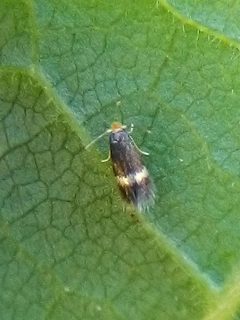
This is externally very similar to several other Stigmella species and cannot be reliably identified based on appearance alone. Genitalic preparation and microscopic examination are essential for definitive identification. The combination of small size, bronze forewings with a silvery-white band at approximately two-thirds wing length, and yellow-haired may suggest S. betulicola, but confirmation requires dissection and examination of genital structures.
Images
Appearance
are tiny bronze-coloured with a wingspan of 3.4–4.6 mm. The forewings are glistening bronze-brown with a broad, silvery-white transverse band positioned about two-thirds along the wing length. The hindwing is narrow, gray, with long fringes. are filamentous, dark, and approximately half the length of the forewing; the innermost joint is greatly expanded and white. is yellow-haired in males, more orange in females; body is dark. Antennal eyecaps are yellow-whitish. Forewings appear shining deep purplish bronze with a shining golden-silvery fascia about 3/4 of the wing length; the area beyond this is deep fuscous-purple.
Habitat
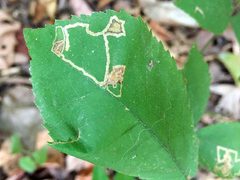
Associated with birch woodlands and areas where birch trees occur. Larval is within the leaves of birch trees.
Distribution
Europe (excluding Iceland, the Iberian Peninsula, and most of the Balkan Peninsula), extending eastward to the eastern . Records include Belgium and other European countries.
Seasonality
are on wing in May and again in August, indicating two per year.
Diet
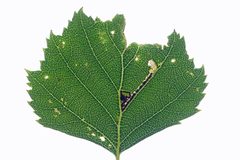
Larvae feed on Betula , including Betula pubescens, Betula pendula, Betula humilis, and Betula nana. They mine the leaves of their plants, feeding internally on leaf tissue.
Host Associations
- Betula pubescens - larval
- Betula pendula - larval
- Betula humilis - larval
- Betula nana - larval
Life Cycle
Two per year (). Larvae are leaf miners that feed internally within birch leaves. presumably occurs within the mine or in leaf litter, though specific details are not documented in available sources.
Behavior
are active during specific periods in spring and late summer. Larvae create mines in birch leaves, feeding between the upper and lower .
Ecological Role
As a on birch, the contributes to the guild of herbivores that process birch foliage, potentially affecting leaf longevity and nutrient cycling in birch-dominated .
Similar Taxa
- Other Stigmella speciesExternally very similar in size, coloration, and wing pattern; genitalic examination required for separation
More Details
Taxonomic note
Originally described as Nepticula betulicola by Stainton in 1856, later transferred to Stigmella by Beirne in 1945.