
Parornix inusitatumella
(Chambers, 1873)
Parornix inusitatumella is a leaf-mining in the Gracillariidae, native to eastern North America. Its larvae feed on hawthorn (Crataegus), creating distinctive blotch mines on leaves. The species has been documented across multiple Canadian provinces and several U.S. states in the Great Lakes and northeastern regions.
Pronunciation
How to pronounce Parornix inusitatumella: //pəˈrɔrnɪks ɪn.juːˈzɪtætəmˈɛlə//
These audio files are automatically generated. While they are not always 100% accurate, they are a good starting point.
Identification
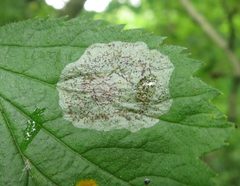
are small typical of the Parornix, with narrow wings and reduced wing venation characteristic of Gracillariidae. Larvae can be identified by their leaf mines: large, white to yellowish-white blotches speckled throughout with , found on Crataegus mollis and Crataegus calpodendron. The mine structure distinguishes this from other Crataegus-feeding leaf miners.
Images
Habitat
Associated with hawthorn (Crataegus) plants in deciduous woodlands, forest edges, and open where Crataegus occur.
Distribution
Eastern North America: Canada (Ontario, Québec, New Brunswick, Nova Scotia, Prince Edward Island); United States (Illinois, Kentucky, Ohio, Michigan, Massachusetts, Maine).
Diet
Larvae are leaf miners of Crataegus mollis and Crataegus calpodendron. feeding habits are unknown.
Host Associations
- Crataegus mollis - larval
- Crataegus calpodendron - larval
Life Cycle
Complete with leaf-mining larval stage. Specific details of site, number of per year, and stage are unknown.
Behavior
Larvae create blotch mines on hawthorn leaves. The mine begins as a small spot and expands to a large, pale blotch with scattered deposits throughout.
Ecological Role
Herbivore; on native hawthorn . May serve as prey for and other natural enemies, though specific records are lacking.
Human Relevance
No known economic or agricultural significance. Occasional minor damage to ornamental hawthorns possible, but not considered a pest.
Similar Taxa
- Other Parornix speciesMany Parornix are leaf miners on Rosaceae; mine characteristics and specificity are primary distinguishing features.
- Phyllonorycter speciesAlso Gracillariidae leaf miners on Crataegus; Phyllonorycter typically create tentiform mines with in a corner, whereas Parornix inusitatumella produces flat blotch mines with scattered frass.
More Details
Mine morphology
The larval mine is described as a large, white or yellowish-white blotch with speckled throughout—distinct from linear mines or tentiform mines of related .