
Micrurapteryx salicifoliella
(Chambers, 1872)
Willow Leaf Blotch Miner Moth
Micrurapteryx salicifoliella is a small leaf-mining in the Gracillariidae, commonly known as the Willow Moth. The is widely distributed across northern North America, from Alaska and Canada to the contiguous United States. Larvae are specialized miners of willow and poplar leaves, creating distinctive blotch mines between the leaf layers. The species is multivoltine, with multiple per year and periods varying geographically from spring through late autumn.
Pronunciation
How to pronounce Micrurapteryx salicifoliella: /maɪˌkruːræpˈtɛrɪks ˌsælɪsɪfoʊˈliɛlə/
These audio files are automatically generated. While they are not always 100% accurate, they are a good starting point.
Identification
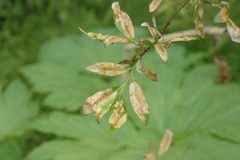
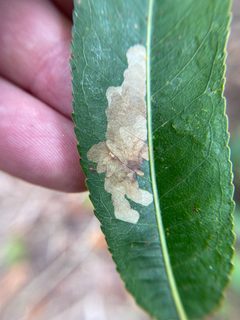
Distinguished from other leaf-mining Gracillariidae by association with Populus and Salix combined with blotch mine . Early instar larvae create linear mines that expand into irregular blotch mines; mature blotch mines are relatively large and conspicuous on willow leaves. identification requires microscopic examination of genitalia; similar small gracillariids on willows include Phyllonorycter species, which typically create tentiform mines with visible patterns differing from the flatter, more diffuse blotch mines of Micrurapteryx.
Images
Appearance
Small with wingspan approximately 9 mm. are minute, with narrow wings typical of Gracillariidae. Larvae are concealed within leaf mines and not readily visible without dissecting leaves.
Habitat
Willow-dominated including riparian corridors, wetlands, floodplains, and forest edges where Salix and Populus plants occur. In interior Alaska, occurs in subarctic boreal forest with extensive willow stands.
Distribution
Northern North America: Canada (Québec, Ontario, Alberta, Saskatchewan, Manitoba, British Columbia, Northwest Territories) and United States (Alaska, Vermont, Kentucky, Michigan, Ohio, Illinois, Minnesota, Missouri, Texas, California).
Seasonality
period varies geographically and appears multivoltine. Illinois: mid to late July, with possible second in October. California: April to October. Texas: November. Alaska: adult begins late May to early June with subsequent generations continuing through summer.
Diet
Larvae feed as leaf miners on Populus (P. balsamifera, P. tremuloides, P. grandidentata) and Salix species (S. alba, S. arbusculoides, S. babylonica, S. bebbiana, S. brachycarpa, S. exigua, S. glauca, S. integra, S. interior, S. lasiandra, S. longifolia, S. monticola, S. novae-angliae, S. planifolia, S. scouleriana).
Host Associations
- Populus balsamifera - larval
- Populus tremuloides - larval
- Populus grandidentata - larval
- Salix alba - larval
- Salix arbusculoides - larval
- Salix babylonica - larval
- Salix bebbiana - larval
- Salix brachycarpa - larval
- Salix exigua - larval
- Salix glauca - larval
- Salix integra - larval
- Salix interior - larval
- Salix lasiandra - larval
- Salix longifolia - larval
- Salix monticola - larval
- Salix novae-angliae - larval
- Salix planifolia - larval
- Salix scouleriana - larval
Life Cycle
Multivoltine with multiple per year. Overwinters as pupae in leaf litter. In Alaska, begins late May to early June with overlapping cohorts continuing through summer. occurs in silken cocoons within the mine or in leaf litter.
Behavior
Larvae are endophagous leaf miners, feeding between upper and lower leaf . Early instars create linear mines that expand into irregular blotch mines as larvae mature. occurs in silken cocoons either within the mine cavity or after exiting to leaf litter.
Ecological Role
herbivore on willows and poplars; leaf mining activity creates localized tissue damage. Serves as prey for and other natural enemies within willow-associated .
Human Relevance
Minor economic significance; occasional pest of ornamental willows and poplars. Leaf mines are conspicuous but rarely cause serious damage to healthy trees. Used as a study organism for understanding and multitrophic interactions.
Similar Taxa
- Phyllonorycter speciesAlso small Gracillariidae that mine willow leaves, but create tentiform mines with distinct accumulation patterns rather than the flat, diffuse blotch mines of Micrurapteryx.
- Other Micrurapteryx species may overlap in distribution and use; definitive identification requires examination of genitalia and mine characteristics.
More Details
Population dynamics
In Alaska, exhibits overlapping with continuous through the growing season, suggesting flexible voltinism responding to local thermal conditions.
Mine morphology
Blotch mines are initially greenish then become brown and translucent as tissue dies; mature mines may coalesce and occupy significant portions of leaf area on heavily infested trees.