
Marmara fasciella
(Chambers, 1875)
White Pine Barkminer Moth
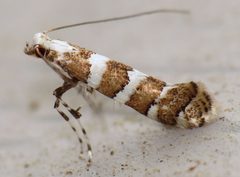
Marmara fasciella, commonly known as the white pine barkminer , is a microlepidopteran in the Gracillariidae. It is distributed in eastern North America, with records from Québec, Canada, and several northeastern and mid-Atlantic U.S. states. The species is associated with coniferous and broadleaf trees, with larvae feeding internally on plants.
Pronunciation
How to pronounce Marmara fasciella: /mɑɹˈmɑɹə ˌfæʃiˈɛlə/
These audio files are automatically generated. While they are not always 100% accurate, they are a good starting point.
Identification
As a member of the Phyllocnistinae, this likely exhibits the characteristic highly reduced venation and elongated body form typical of bark-mining gracillariids. are small with narrow wings. Definitive identification requires examination of genitalia or molecular analysis.
Images
Habitat
Associated with forested supporting its larval plants, including coniferous forests with white pine and mixed forests with oak .
Distribution
Recorded from Québec, Canada, and the United States in Kentucky, Maryland, New York, Vermont, and Maine. GBIF records additionally indicate presence in New Brunswick and Ontario, Canada.
Seasonality
are on wing from May to early July.
Diet
Larvae feed internally on Quercus , Abies balsamea (balsam fir), Pinus monticola (western white pine), and Pinus strobus (eastern white pine).
Host Associations
- Quercus - larval food plantbroadleaf
- Abies balsamea - larval food plantconifer
- Pinus monticola - larval food plantconifer
- Pinus strobus - larval food plantconifer ; namesake of
Life Cycle
Larvae are internal feeders, mining within plant tissues. Specific details of and stages are not documented.
Behavior
are or flyers active during late spring and early summer. Larvae are concealed feeders within plant bark or stems.
Ecological Role
As a phytophagous on multiple tree , larvae contribute to nutrient cycling through their feeding activity. The may serve as prey for and other natural enemies, though specific records are lacking.
Human Relevance
Minor potential significance in forestry due to association with economically important conifers including eastern white pine and balsam fir. Not documented as a significant pest.
Similar Taxa
- Other Marmara speciesThe Marmara contains multiple bark-mining that are morphologically similar and require dissection or molecular methods for reliable identification.
- Phyllocnistis speciesRelated leaf-mining gracillariids in the same ; distinguished by larval habit (leaf mines vs. bark mines) and associations.
More Details
Taxonomic note
Originally described as Aesyle fasciella by Chambers in 1875, later transferred to Marmara. The genus name refers to the marble-like appearance of some .
Observation frequency
iNaturalist records indicate this has been observed over 1,300 times, suggesting it is not rare within its range, though it may be undercollected due to its small size and concealed larval habit.
Sources and further reading
- BugGuide
- Wikipedia
- GBIF taxonomy match
- iNaturalist taxon
- NCBI Taxonomy
- Catalogue of Life
- A Tiny and Beautiful Moth from Texas | Bug Squad
- Stories about small insects and making a big difference - Buglife Blog - Buglife
- Reversing insect declines – a matter of personal responsibility before our own existence - Buglife Blog - Buglife
- Surveying the Horehound Long-horn Moth - Buglife Blog - Buglife
- The great potential of citizen science - an opportunity to work together more in the name of preserving insects in 2021 - Buglife Blog - Buglife
- Uncategorized | Blog - Part 41