
Marmara arbutiella
Busck, 1904
Madrone Skin Miner
Marmara arbutiella is a minute in the Gracillariidae, commonly known as the Madrone Skin Miner. It is characterized by an exceptionally small wingspan of approximately 4 mm. The is known from western North America, with records from Canada and the United States. Larvae are leaf miners that feed on Arbutus and Arctostaphylos species.
Pronunciation
How to pronounce Marmara arbutiella: /mɑrˈmɑːrə ɑrˌbjuːtiˈɛlə/
These audio files are automatically generated. While they are not always 100% accurate, they are a good starting point.
Identification
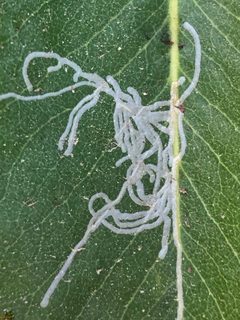
Distinguished from other Marmara by plant association and geographic distribution. Identification to species level requires examination of genitalia or molecular analysis. The extremely small size (4 mm wingspan) places it among the smallest Lepidoptera. Larval mines on Arbutus and Arctostaphylos leaves provide a field indicator.
Images
Appearance
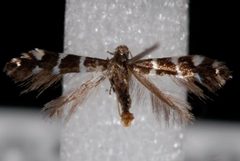
Extremely small with wingspan of approximately 4 mm. The exhibits the reduced size typical of microlepidoptera. Specific coloration and pattern details are not well documented in available sources.
Habitat
Associated with plants in forested and chaparral where Arbutus menziesii (Pacific madrone), Arbutus unedo (strawberry tree), and Arctostaphylos (manzanitas) occur. Specific microhabitat preferences for are not documented.
Distribution
Canada (British Columbia) and United States (Oregon, Washington, and California). Distribution corresponds to the range of its primary plants in western North America.
Diet
Larvae feed on Arbutus menziesii, Arbutus unedo, and Arctostaphylos . They mine the leaves of their plants, creating internal feeding tunnels between the leaf surfaces.
Host Associations
- Arbutus menziesii - Pacific madrone
- Arbutus unedo - Strawberry tree
- Arctostaphylos - Manzanita
Life Cycle
Complete with , larval, pupal, and stages. Larvae are leaf miners that feed internally within plant leaves. Specific details of site and number of per year are not documented.
Behavior
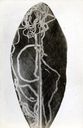
is poorly documented. Larvae create serpentine or blotch mines in leaves of plants, feeding between the upper and lower .
Ecological Role
As a , larvae may influence leaf physiology and nutrient cycling in plants. Specific ecological impacts have not been quantified.
Human Relevance
Minor potential as an for health in western North American forests. No significant economic or agricultural impact documented.
Similar Taxa
- Other Marmara speciesSimilar minute size and leaf-mining habit; require genitalia examination or plant association for differentiation
- Phyllocnistis speciesAlso in Phyllocnistinae with serpentine leaf mines; distinguished by mine pattern and specificity
More Details
Taxonomic history
Described by Busck in 1904. The Marmara contains numerous minute that are challenging to identify without specialized examination.
Collection notes
Specimens are typically collected by rearing from plant mines or by specialized light trapping for microlepidoptera. The is represented in collections including the Bohart Museum of Entomology.
Sources and further reading
- BugGuide
- Wikipedia
- GBIF taxonomy match
- iNaturalist taxon
- NCBI Taxonomy
- Catalogue of Life
- A Tiny and Beautiful Moth from Texas | Bug Squad
- Uncategorized | Blog - Part 41
- Uncategorized | Blog - Part 18
- New fish species described from the streams of Manyas Lake basin, Turkey | Blog
- A new trout species described from the Alakır Stream in Antalya, Turkey | Blog