
Porphyrosela minuta
Clarke, 1953
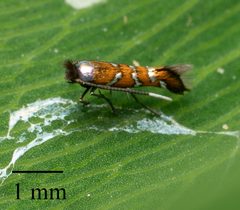
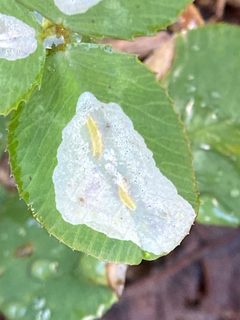
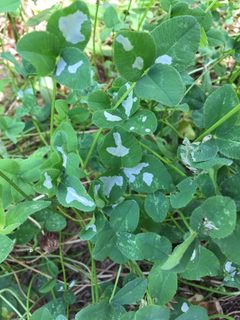
A tiny leaf-mining in the Gracillariidae, Porphyrosela minuta creates distinctive white blotch mines on clover leaves. Native to South America, it has established in North America following recent introduction. The is multivoltine with rapid development, completing its in approximately 16 days at 25°C. are minute and difficult to observe in the field.
Pronunciation
How to pronounce Porphyrosela minuta: /ˌpɔːrfɪroʊˈsiːlə maɪˈnjuːtə/
These audio files are automatically generated. While they are not always 100% accurate, they are a good starting point.
Identification
Distinguished from other Gracillariidae by its association with Trifolium and Medicago plants. Larval mines appear as white blotches on upper leaf surfaces rather than linear trails. are extremely small, making field observation challenging. -level identification typically requires examination of genitalia or pupal characteristics.
Images
Habitat
Parks and rural areas with ground cover vegetation, particularly where white clover and other Trifolium grow. In Uruguay, occurs widely in southern regions with suitable plant availability.
Distribution
Native to South America: Argentina, Brazil, Chile, and Uruguay (where it is widely distributed in the south). Introduced to North America with established in California, Louisiana, Maryland, North Carolina, and Oklahoma.
Seasonality
Multivoltine with 7-9 annually from November through March in Uruguay. Activity corresponds with plant growing season and favorable temperatures.
Diet
Larvae feed internally as leaf miners on white clover (Trifolium repens) and other Trifolium including Trifolium pratense. Also recorded from Medicago sativa (alfalfa). Early instars possess sap-feeding mouthparts to lacerate and ingest liquid contents; later instars develop chewing mouthparts. have been observed feeding on honey in laboratory settings.
Host Associations
- Trifolium repens - larval plantprimary , white clover
- Trifolium pratense - larval plantred clover
- Medicago sativa - larval plantalfalfa
Life Cycle
Complete with five larval instars. At 25°C: stage 3.0 days, larval stage 8.8 days, pupal stage 4.4 days; total time 16.2 days. Larvae develop entirely within leaf mines without remaining exposed. occurs within the mine. Sex determination requires microscopic examination of pupal to observe genital aperture position.
Behavior
Larvae feed entirely within leaf tissue, creating extensive white blotch mines on upper leaf surfaces. Females begin oviposition on the first night after , laying singly on upper leaflet surfaces. are cryptic and difficult to detect due to minute size.
Ecological Role
Leaf-mining herbivore on clover . Damage consists of conspicuous white mines but is not considered economically significant. Common and sometimes relatively abundant in spring and summer when plants are actively growing.
Human Relevance
Minor agricultural pest of clover and alfalfa, though damage is generally not economically important. Presence in North America represents a recent introduction with potential for range expansion.
Similar Taxa
- Porphyrosela desmodiellaCongeneric with similar and leaf-mining habit; distinguished by plant associations and subtle morphological differences
- Other Lithocolletinae leaf minersCreate similar blotch mines; require examination of mine characteristics, plant, and for separation
Sources and further reading
- BugGuide
- Wikipedia
- GBIF taxonomy match
- iNaturalist taxon
- NCBI Taxonomy
- Catalogue of Life
- Tiny raptors: Mantisflies, Mantispidae, and Praying mantises, Mantidae — Bug of the Week
- Bug Eric: Last Night to Blacklight?
- For an Understudied Ant Genus, Two Researchers Choose a "Bird Guide" ID Tool
- Bug Eric: October 2022
- Uncategorized | Blog - Part 12
- Morphology and biology of Porphyrosela minuta Clarke 1953 (Lepidoptera: Gracillariidae, Lithocolletinae) in Uruguay