
Porphyrosela desmodiella
(Clemens, 1859)
Tentiform Bean Leafminer
Porphyrosela desmodiella is a minute leaf-mining in the Gracillariidae, with a wingspan of 4.5–5 mm. It is widely distributed across the eastern and central United States, southern Canada, and parts of the Caribbean and South America. The larvae are specialized leaf miners on leguminous plants (Fabaceae), creating distinctive mines on foliage.
Identification
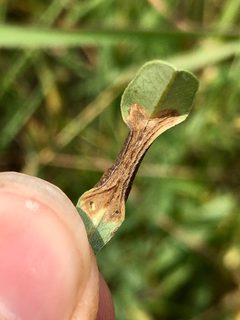
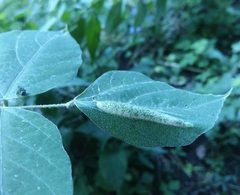
The extremely small size (4.5–5 mm wingspan) distinguishes this from most other Lepidoptera. Among Gracillariidae, identification to species requires examination of genitalia or association with plant and larval mine characteristics. The tentiform leaf mines on Fabaceae hosts, particularly Desmodium species, provide a strong indicator when are reared from confirmed host material. Distinguishing from congeneric species requires taxonomic knowledge.
Images
Appearance
are extremely small with a wingspan of 4.5–5 mm. As a member of Gracillariidae, adults likely exhibit the -typical narrow, wings with reduced venation and long, slender bodies characteristic of microlepidoptera. Specific coloration and pattern details are not documented in available sources.
Habitat
Associated with supporting its leguminous plants, including open woodlands, forest edges, meadows, and agricultural or areas where Fabaceae occur. Specific microhabitat preferences for are undocumented.
Distribution
Documented from Brazil, Cuba, the Virgin Islands (Saint Thomas), Canada (Ontario), and the United States (Arizona, Connecticut, Florida, Georgia, Indiana, Kentucky, Maine, Maryland, Missouri, New York, North Carolina, Pennsylvania, South Carolina, Tennessee, Texas, Vermont, Washington).
Diet
Larvae feed as leaf miners on multiple of Fabaceae: Bradburya, Centrosema virginianum, Desmodium (including D. tortuosum, D. viridiflorum), Lespedeza (including L. bicolor, L. capitata, L. thunbergii), Phaseolus, Strophostyles leiosperma, and Trifolium repens. feeding habits are unknown.
Host Associations
- Bradburya - larval Fabaceae
- Centrosema virginianum - larval Fabaceae
- Desmodium tortuosum - larval Fabaceae
- Desmodium viridiflorum - larval Fabaceae
- Lespedeza bicolor - larval Fabaceae
- Lespedeza capitata - larval Fabaceae
- Lespedeza thunbergii - larval Fabaceae
- Phaseolus - larval Fabaceae; includes cultivated beans
- Strophostyles leiosperma - larval Fabaceae
- Trifolium repens - larval Fabaceae; white clover
Life Cycle
Larvae develop as leaf miners within plant foliage. Specific details regarding placement, number of instars, site, and voltinism are not documented in available sources.
Behavior
Larvae construct tentiform leaf mines—characteristic blotch mines with silk-lined, tent-like folds—on plant leaves. are presumably or , as typical for Gracillariidae.
Ecological Role
As a , larvae function as primary consumers of Fabaceae foliage. Their specialized feeding may influence plant , though -level impacts are undocumented. The likely serves as prey for and other natural enemies, though specific parasitoid associations are not recorded.
Human Relevance
Larvae have been recorded from Phaseolus (beans), indicating potential association with cultivated legumes. The 'Tentiform Bean Leafminer' suggests agricultural recognition, though economic significance is not quantified in available sources.
Similar Taxa
- Other Porphyrosela speciesCongeneric share similar size, , and leaf-mining habits on Fabaceae; require genitalia examination or plant association for reliable separation.
- Phyllonorycter speciesAlso Gracillariidae leaf miners that produce tentiform mines on various ; distinguished by different host plant preferences and .
More Details
Taxonomic history
Originally described as Lithocolletis desmodiella by Clemens in 1859, later transferred to Porphyrosela.