
Phyllonorycter scudderella
(Frey & Boll, 1873)
Phyllonorycter scudderella is a micro- in the Gracillariidae. It is widespread across North America, with in the east from Ontario to Ohio and in the west from south-eastern Alaska to Oregon. The is known to have two per year in at least part of its range. Larvae are leaf miners on willow species.
Pronunciation
How to pronounce Phyllonorycter scudderella: //fɪloʊˈnɒrɪktər skʌdəˈrɛlə//
These audio files are automatically generated. While they are not always 100% accurate, they are a good starting point.
Identification
Identification to level requires examination of genitalia or molecular methods. The Phyllonorycter contains many similar-looking species; P. scudderella is distinguished by plant association with Salix species and geographic distribution. Forewing length of 3-4.3 mm and in spring and summer/autumn may aid in narrowing possibilities within its range.
Images
Appearance
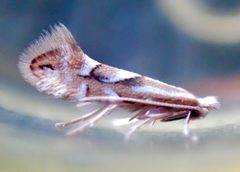
A small with forewing length of 3-4.3 mm. As with other Phyllonorycter , are tiny and require magnification for reliable identification. Specific coloration and pattern details are not well documented in available sources.
Habitat
Associated with willow , including riparian zones and wetlands where Salix occur. Specific microhabitat preferences for are not documented.
Distribution
Widespread in North America: eastern from Ontario to Ohio; western populations from south-eastern Alaska to Oregon. Additional records from Alberta, British Columbia, Manitoba, Newfoundland and Labrador, and Nova Scotia.
Seasonality
are active from mid-March to early May and from late June to early October, indicating two per year.
Diet
Larvae feed on leaves of Salix babylonica, Salix bebbiana, Salix discolor, and Salix candida. feeding habits are unknown.
Host Associations
- Salix babylonica - larval larvae mine leaves
- Salix bebbiana - larval larvae mine leaves
- Salix discolor - larval larvae mine leaves
- Salix candida - larval larvae mine leaves
Life Cycle
Probably two per year based on periods. Larvae are leaf miners, feeding inside leaves of willows. Specific details of and stage are not documented.
Behavior
are attracted to light. Larvae create leaf mines in plant foliage.
Ecological Role
As a , larvae may affect photosynthetic capacity of willow leaves. Specific ecological impacts are not quantified. The contributes to the diverse of herbivores associated with Salix species in North America.
Human Relevance
No documented economic or direct human relevance. Not known to be a pest of ornamental or economically important willow plantings.
Similar Taxa
- Other Phyllonorycter speciesMany are similar in size and appearance; identification requires genitalia examination or plant and geographic data.
- Phyllonorycter salicifoliellaAlso associated with Salix ; may overlap in range and require careful differentiation.
More Details
Taxonomic history
Originally described as Lithocolletis scudderella by Frey & Boll in 1873, later transferred to Phyllonorycter.