
Phyllonorycter propinquinella
(Braun, 1908)
cherry blotch miner moth, cherry blotchminer
Phyllonorycter propinquinella is a microlepidopteran in the Gracillariidae, commonly known as the cherry blotch miner moth. It is a leaf-mining whose larvae feed on black cherry (Prunus serotina). The species is restricted to northeastern North America, with records from Canada and the eastern United States.
Pronunciation
How to pronounce Phyllonorycter propinquinella: //ˌfɪl.oʊ.nɔːˈɹɪk.təɹ ˌproʊ.pɪŋ.kwɪˈnɛl.ə//
These audio files are automatically generated. While they are not always 100% accurate, they are a good starting point.
Identification
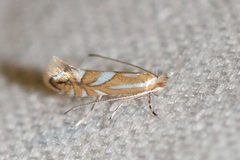
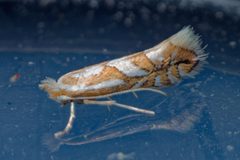
Minute size (8–9 mm wingspan) and association with Prunus serotina plants are key indicators. Definitive identification requires examination of male genitalia or , as Phyllonorycter are morphologically similar and often distinguishable only by genitalic characters or host association. The specific epithet 'propinquinella' refers to its close relationship to similar species.
Images
Appearance
are minute with a wingspan of 8–9 mm. Like other Phyllonorycter , they have narrow, wings with characteristic patterning. The is distinguished by having only the first pair of legs with epiphyses (spurs), and male genitalia with a distinctive gnathos structure.
Habitat
Deciduous forests and woodlands where black cherry (Prunus serotina) occurs. The is associated with the plant's natural range in temperate eastern North America.
Distribution
Northeastern North America: Canada (Québec, Nova Scotia, Ontario) and United States (Connecticut, Illinois, Maine, Maryland, Michigan, New York, Ohio, Vermont).
Seasonality
have been recorded in July and August based on light trap captures. Specific period data are limited.
Diet
Larvae are specialized feeders on black cherry (Prunus serotina), mining the leaves. The mining pattern creates blotches on the leaf surface.
Host Associations
- Prunus serotina - larval plantLarvae feed as leaf miners on this
Life Cycle
Complete with , larval, pupal, and stages. Larvae are leaf miners that feed within the leaf tissue of Prunus serotina, creating blotch mines. occurs within the mine or in a silken cocoon on the ground. Specific details of voltinism and stage are not documented.
Behavior
are and attracted to light. Larvae are endophagous leaf miners, feeding internally in leaves.
Ecological Role
As a , larvae contribute to herbivore pressure on black cherry . The serves as prey for and other natural enemies, though specific records are not documented.
Human Relevance
No significant economic or agricultural impact. The is of interest to lepidopterists and naturalists studying leaf-mining diversity.
Similar Taxa
- Phyllonorycter emberizaepenellaAlso feeds on Prunus , but distinguished by range and genitalic characters
- Phyllonorycter cerasicolellaAnother cherry-feeding Phyllonorycter ; separation requires examination of male genitalia or plant specificity
- Other Phyllonorycter speciesMany are morphologically similar and require dissection or analysis for definitive identification
More Details
Taxonomic history
Originally described as Lithocolletis propinquinella by Braun in 1908, later transferred to Phyllonorycter. The epithet refers to its close resemblance to related species.
Conservation status
Not evaluated by IUCN. Appears to be locally common within its restricted range but may be vulnerable to loss affecting black cherry .