
Phyllonorycter emberizaepenella
(Bouché, 1834)
Large Midget
A small leaf-mining in the Gracillariidae with a wingspan of 9–10 mm. It reproduces exclusively by , with no males known to exist. Females nevertheless display calling and produce compounds, despite the absence of mate attraction. The is widespread across Europe and has been introduced to North America.
Pronunciation
How to pronounce Phyllonorycter emberizaepenella: /ˌfɪl.oʊ.nəˈɹɪk.tər ˌɛm.bəˌraɪ.zəˈpɛn.ɛl.ə/
These audio files are automatically generated. While they are not always 100% accurate, they are a good starting point.
Identification
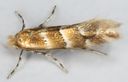
Distinguished from other Phyllonorycter by the specific pattern of golden-ochreous forewings with whitish fasciae and wedge-shaped spots margined with blackish . The combination of a short whitish streak from base, paired fasciae at 1/4 and 1/2, and multiple wedge-shaped spots is diagnostic. Similar species in the may share general coloration but differ in precise marking patterns.
Images
Habitat
Associated with stands of Lonicera (honeysuckle) and Symphoricarpos (snowberry), where larval plants occur. Specific preferences of beyond host plant vicinity are not well documented.
Distribution
Native to Europe, occurring throughout the continent except the Iberian Peninsula and Balkan Peninsula. Introduced to North America with records from Nova Scotia, Ontario, Quebec (Canada), and West Siberia (Russia).
Seasonality
Two per year; active in May and again in August.
Diet
Larvae feed as leaf miners on leaves of Lonicera (L. alpigena, L. × bella, L. caerulea, L. deflexicalyx, L. flava, L. gracilipes, L. ledebourii, L. maackii, L. morrowii, L. nigra, L. orientalis, L. periclymenum, L. prostrata, L. rupicola, L. tatarica, L. webbiana, L. xylosteum) and Symphoricarpos albus. feeding habits not documented.
Host Associations
- Lonicera alpigena - larval leaf mining
- Lonicera × bella - larval leaf mining
- Lonicera caerulea - larval leaf mining
- Lonicera deflexicalyx - larval leaf mining
- Lonicera flava - larval leaf mining
- Lonicera gracilipes - larval leaf mining
- Lonicera ledebourii - larval leaf mining
- Lonicera maackii - larval leaf mining; non-native exploited in North America
- Lonicera morrowii - larval leaf mining
- Lonicera nigra - larval leaf mining
- Lonicera orientalis - larval leaf mining
- Lonicera periclymenum - larval leaf mining
- Lonicera prostrata - larval leaf mining
- Lonicera rupicola - larval leaf mining
- Lonicera tatarica - larval leaf mining
- Lonicera webbiana - larval leaf mining
- Lonicera xylosteum - larval leaf mining
- Symphoricarpos albus - larval leaf mining
Life Cycle
Two per year (). Larvae develop as leaf miners within plant leaves. presumably occurs within the mine or in leaf litter, though specific details are not documented.
Behavior
Females exhibit calling posture to release compounds despite complete absence of males and no need for mate attraction. Field experiments showed no males attracted to pheromone-baited traps or virgin females. The calling and pheromone chemistry resemble those of amphimictic (sexually reproducing) Lepidoptera .
Ecological Role
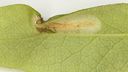
; creates blotch mines in leaves of Lonicera and Symphoricarpos. Serves as prey for native birds in North America where it has been introduced.
Human Relevance
Has been exploited as prey by native birds in North America using the non-native Lonicera maackii, demonstrating ecological integration following introduction. No significant economic impact documented.
Similar Taxa
- Other Phyllonorycter speciesShare similar size, golden-ochreous coloration, and leaf-mining habit; distinguished by precise pattern of whitish fasciae and wedge-shaped spots with blackish margins on forewings
More Details
Reproductive system
The reproduces by , a form of in which females produce female offspring without . Males are completely absent. Two potential components have been identified: (8E,10E)-8,10-tetradecadienyl acetate and (8E,10E)-8,10-tetradecadienol (trace amounts). The persistence of calling and production in a parthenogenetic species contradicts theoretical predictions that thelytoky would reduce or eliminate sexual signaling behaviors.
Introduction to North America
The has been introduced to North America and has been documented exploiting the non-native shrub Lonicera maackii (Amur honeysuckle) as a larval . Native birds have been observed exploiting P. emberizaepenella larvae using this host, indicating ecological integration into the novel .