
Phyllonorycter lucetiella
(Clemens, 1859)
Basswood Miner Moth
Phyllonorycter lucetiella is a micro- in the Gracillariidae, commonly known as the Basswood Miner Moth. are extremely small with a wingspan of 6–7 mm. The is native to eastern North America, where larvae create distinctive tentiform leaf mines on plants. It is one of many Phyllonorycter species specialized in mining leaves of deciduous trees.
Pronunciation
How to pronounce Phyllonorycter lucetiella: /ˌfɪloʊnɔːˈrɪktər luːˌsɛtiˈɛlə/
These audio files are automatically generated. While they are not always 100% accurate, they are a good starting point.
Identification
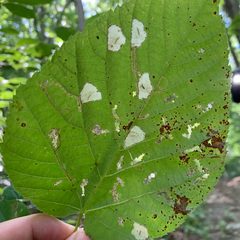
are extremely small (6–7 mm wingspan) and require microscopic examination or genital dissection for definitive identification. The larval leaf mine is highly diagnostic: a rectangular, often nearly square tentiform mine on the underside of leaves, placed between two , unwrinkled, and conspicuously visible from the upperside due to removal of green parenchyma tissue from the upper wall. When complete, the mine becomes transparent, revealing the pupa in its oval cocoon. This mine shape and placement distinguishes it from other Phyllonorycter on Tilia and Ostrya.
Images
Appearance
are minute with wingspan 6–7 mm. Like other Phyllonorycter , adults have narrow, wings with distinctive patterning of white and brown or golden markings. The body is slender and compact, typical of microlepidoptera in Gracillariidae.
Habitat
Deciduous forests and urban areas where trees (Tilia and Ostrya virginiana) are present. The species is associated with temperate broadleaf woodland in eastern North America.
Distribution
Eastern North America: Canada (Québec, Ontario, New Brunswick, Nova Scotia); United States (Illinois, Kentucky, Pennsylvania, Florida, Georgia, Maine, Maryland, Michigan, New York, Vermont, Connecticut, Massachusetts, Alabama).
Diet
Larvae feed on leaves of Ostrya virginiana (hop hornbeam) and Tilia including Tilia americana (American basswood), Tilia × vulgaris, and Tilia × europaea. Larvae are leaf miners that feed on parenchyma tissue between leaf surfaces.
Host Associations
- Ostrya virginiana - larval Hop hornbeam
- Tilia americana - larval American basswood
- Tilia × vulgaris - larval Hybrid linden
- Tilia × europaea - larval European linden hybrid
Life Cycle
Larvae create tentiform mines in leaves, feeding between upper and lower . The mine is rectangular to nearly square, placed between two . When feeding is complete, the larva pupates within an oval cocoon inside the transparent mine. are and attracted to light.
Behavior
are attracted to light at night. Larvae are endophagous leaf miners that feed internally within leaf tissue. The rectangular, -bound mine structure appears to be an for efficient resource extraction while minimizing detection by .
Ecological Role
As a , larvae contribute to nutrient cycling by creating entry points for fungal decomposers and accelerating leaf . The is part of the diverse of microlepidopteran herbivores on deciduous trees. and likely exploit larvae within mines.
Human Relevance
Minor aesthetic impact on ornamental Tilia plantings due to leaf mining damage. Not considered a significant economic pest. The is documented in citizen science platforms and is subject to ongoing taxonomic and distributional study.
Similar Taxa
- Other Phyllonorycter speciesMany create tentiform leaf mines on similar plants; mine shape (rectangular/square, between , unwrinkled) and host specificity are key distinguishing features
- Cameraria speciesAlso Gracillariidae leaf miners, but typically create blotch mines rather than tentiform mines; Phyllonorycter mines are more angular and structured
More Details
Original description
Originally described as Lithocolletis lucetiella by Clemens in 1859, later transferred to Phyllonorycter.