
Phyllonorycter holodisci
(Braun, 1939)
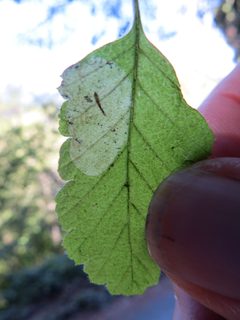
Phyllonorycter holodisci is a small in the Gracillariidae, described by Annette Braun in 1939. The is to western North America, with confirmed records from California, Oregon, Washington, Idaho, and British Columbia. Its larvae are specialized leaf miners that feed exclusively on Holodiscus discolor, a shrub commonly known as ocean spray or creambush. The mine is constructed on the upper surface of the leaf.
Pronunciation
How to pronounce Phyllonorycter holodisci: /ˌfɪloʊnɔːˈrɪktər hoʊloʊˈdɪskaɪ/
These audio files are automatically generated. While they are not always 100% accurate, they are a good starting point.
Identification
are minute with wingspans under 10 mm, typical of the Phyllonorycter. Specific diagnostic features for P. holodisci include genitalia and association with the plant Holodiscus discolor. The may be distinguished from other Phyllonorycter species by examination of male genitalia, particularly the valvae and structure. The upper-surface leaf mine on Holodiscus discolor is a reliable indicator of larval presence.
Images
Habitat
Associated with stands of Holodiscus discolor, a deciduous shrub of coastal and montane regions. The plant grows in open forests, forest edges, and disturbed areas from sea level to moderate elevations. occurrence correlates with host plant distribution in western North America.
Distribution
Pacific coastal region of western North America. Documented from California, Oregon, Washington, and Idaho in the United States, and British Columbia in Canada. The distribution corresponds closely with that of the plant Holodiscus discolor.
Diet
Larvae feed on leaves of Holodiscus discolor. do not feed; they rely on energy reserves accumulated during the larval stage.
Host Associations
- Holodiscus discolor - Larval plant; larvae mine upper leaf surfaces
Life Cycle
Larvae develop as leaf miners within the upper of Holodiscus discolor leaves. The mine is a blotch type, located on the upper side of the leaf. occurs within the mine or in a silken cocoon on the leaf surface. are active during the growing season of the plant. Specific details regarding voltinism and stage have not been documented.
Behavior
Larvae are sedentary leaf miners, feeding between the upper and mesophyll of leaves. are likely and attracted to light, as observed in other Phyllonorycter . The species has been recorded at blacklight traps in Colorado, though this is outside the documented host plant range and may represent misidentification or vagrant individuals.
Ecological Role
As a specialized herbivore, the contributes to leaf damage on Holodiscus discolor. The mining habit creates localized but rarely causes significant plant mortality. The species serves as prey for and , though specific natural enemies have not been documented.
Human Relevance
No known economic or agricultural significance. The is not considered a pest. It may be of interest to lepidopterists studying Gracillariidae diversity and specialization patterns.
Similar Taxa
- Phyllonorycter spp.Numerous congeneric occur in western North America; most are distinguished by plant association and genitalia . P. holodisci is reliably identified only by association with Holodiscus discolor and examination of genitalia.
- Cameraria spp.Another of Gracillariidae with upper-surface leaf miners; distinguished by mine and larval cephalic structure. Cameraria mines often have multiple folds or creases, whereas Phyllonorycter mines are typically more planar blotches.
More Details
Taxonomic history
Described by Annette Frances Braun in 1939 based on specimens from California. The specific epithet holodisci is derived from the plant Holodiscus, reflecting the tight ecological association that was recognized at the time of description.
Collection records
GBIF distribution records indicate occurrence in California, Oregon, Washington, Idaho, and British Columbia. iNaturalist observations (n=42 as of source date) support this western North American distribution.