
Cameraria quercivorella
(Chambers, 1879)
Rusty Oak Leafminer
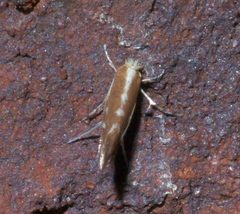
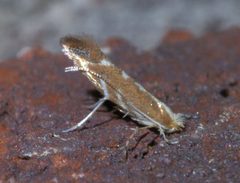
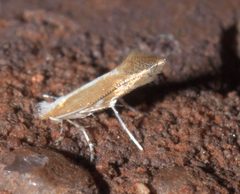
A small leaf-mining in the Gracillariidae, known from eastern North America. are tiny with a wingspan of 6.5–7 mm. Larvae create distinctive blotch mines on the upper surface of oak leaves.
Pronunciation
How to pronounce Cameraria quercivorella: /kæməˈrɛəriə kwɜːrsɪˈvɔrɛlə/
These audio files are automatically generated. While they are not always 100% accurate, they are a good starting point.
Identification
Distinguished from other Cameraria by association with specific oak (Quercus obtusiloba, Q. rubra, Q. stellata) and the form of larval leaf mines: blotch mines on the upper leaf surface. identification requires examination of genitalia or molecular analysis.
Images
Appearance
Very small with wingspan 6.5–7 mm. Specific coloration and pattern details not documented in available sources.
Habitat
Oak-dominated forests and woodlands where occur. Specific microhabitat preferences of not documented.
Distribution
Eastern North America: Canada (Ontario, Quebec, Nova Scotia) and United States (Kentucky, Florida, Georgia, Maine, Maryland, Michigan, New York, Texas, Vermont, Illinois).
Diet
Larvae feed on Quercus obtusiloba, Quercus rubra, and Quercus stellata. feeding habits unknown.
Host Associations
- Quercus obtusiloba - larval food plant
- Quercus rubra - larval food plant
- Quercus stellata - larval food plant
Life Cycle
Larvae mine leaves of oaks, creating blotch mines on the upper leaf surface. Specific details of , pupal, and stages not documented.
Behavior
Larvae are leaf miners, feeding internally within leaf tissue. not described in available sources.
Ecological Role
As a , larvae may influence oak leaf physiology and contribute to nutrient cycling through leaf damage. Specific ecological impacts not quantified.
Human Relevance
No documented economic or medical significance. Occasionally encountered by naturalists and entomologists studying leaf-mining insects.
Similar Taxa
- Other Cameraria speciesMany Cameraria are oak leaf miners with similar ; identification requires association or genitalia examination.
More Details
Leaf mine characteristics
The larval mine is a blotch mine on the upper surface of the leaf, as opposed to linear mines or lower-surface mines found in some related .
Nomenclature
Originally described as Lithocolletis quercivorella by Chambers in 1879; later transferred to Cameraria.