
Cameraria obstrictella
(Clemens, 1859)
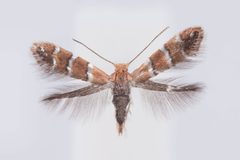
Cameraria obstrictella is a small in the Gracillariidae, first described by Clemens in 1859. It is found in eastern North America, where its larvae create leaf mines on oak and wax myrtle. The species has a wingspan of 7–8 mm.
Pronunciation
How to pronounce Cameraria obstrictella: /kæməˈrɛəriə ˌɒbstrɪkˈtɛlə/
These audio files are automatically generated. While they are not always 100% accurate, they are a good starting point.
Identification
The can be distinguished from other Cameraria species by its association with specific plants (Quercus species and Myrica cerifera) and its documented distribution in eastern North America. Accurate identification requires examination of genitalia or molecular analysis, as external is similar to .
Images
Appearance
Small with a wingspan of 7–8 mm. Specific coloration and pattern details are not documented in available sources.
Habitat
Deciduous forests and woodlands containing oak (Quercus) and areas with wax myrtle (Myrica cerifera). Specific microhabitat preferences are not documented.
Distribution
Eastern Canada: Ontario, Quebec. Eastern United States: New York, Ohio, Kentucky, Maine, Vermont, Pennsylvania.
Diet
Larvae feed on leaves of Quercus (including Quercus acuminata, Quercus alba, Quercus montana, Quercus muehlenbergii, Quercus rubra, Quercus tinctoria, and Quercus velutina) and Myrica cerifera. They mine the leaves of their plants, feeding internally between the leaf surfaces.
Host Associations
- Quercus acuminata - larval leaf mining
- Quercus alba - larval leaf mining
- Quercus montana - larval leaf mining
- Quercus muehlenbergii - larval leaf mining
- Quercus rubra - larval leaf mining
- Quercus tinctoria - larval leaf mining
- Quercus velutina - larval leaf mining
- Myrica cerifera - larval leaf mining
Life Cycle
Larvae are leaf miners, developing inside the leaves of plants. Specific details regarding placement, site, number of per year, and stage are not documented.
Behavior
Larvae create blotch or serpentine leaf mines on plant foliage. patterns are not documented.
Ecological Role
As a leaf-mining herbivore, larvae may contribute to localized leaf damage on oak and wax myrtle . Specific ecological impacts are not quantified.
Human Relevance
No documented economic or agricultural significance. Occasionally encountered by naturalists and lepidopterists in eastern North American forests.
Similar Taxa
- Other Cameraria speciesExternal is highly similar among ; reliable identification requires dissection or plant association records.
- Other Gracillariidae leaf miners on QuercusMultiple within Gracillariidae mine oak leaves; mine pattern and larval may differ but require expert examination.
More Details
Taxonomic history
First described by James Brackenridge Clemens in 1859. The specific epithet 'obstrictella' derives from Latin, though the precise etymological meaning is not documented in available sources.
Observation frequency
Relatively few documented observations (12 records on iNaturalist as of source date), suggesting the may be underreported or genuinely uncommon.