
Cameraria hamameliella
(Busck, 1903)
Witchhazel Leafminer
Cameraria hamameliella is a minute leaf-mining in the Gracillariidae, first described by August Busck in 1903. The is narrowly associated with witchhazel (Hamamelis) as its larval , with larvae creating distinctive mines within leaves. It occurs throughout eastern North America, where it is the primary leafminer documented on native Hamamelis virginiana.
Pronunciation
How to pronounce Cameraria hamameliella: /ˌkæməˈrɛriə hæməˌmiˈliɛlə/
These audio files are automatically generated. While they are not always 100% accurate, they are a good starting point.
Identification
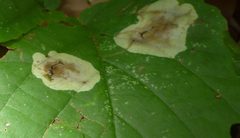
The combination of minute size (7 mm wingspan), specific association with Hamamelis plants, and the distinctive serpentine to blotch leaf mines on witchhazel leaves distinguishes this . Among eastern North American Cameraria, it is separated by host specificity; other species in the occur on unrelated hosts such as oaks, maples, or legumes. The mine pattern—beginning as a narrow serpentine track that widens into an irregular blotch—is characteristic of the genus and, on witchhazel, indicates this species.
Images
Appearance
are extremely small with a wingspan of approximately 7 mm. The forewings display the characteristic patterning typical of Cameraria, with alternating light and dark transverse bands creating a mottled, speckled appearance. The hindwings are narrower and paler. Larvae are minute, pale, and flattened, adapted for life between the upper and lower leaf .
Habitat
Occurs in deciduous forests, woodlands, and shaded areas where witchhazel (Hamamelis virginiana and related ) grows naturally. Favors moist to mesic sites with well-drained soils. Often found in ravines, stream banks, and forest understories where witchhazel is a common understory shrub or small tree.
Distribution
Eastern North America: Canada (Ontario, Québec, Nova Scotia) and the eastern United States, including Massachusetts, Connecticut, New York, Maryland, Michigan, Kentucky, and Maine.
Seasonality
period has been observed from spring through summer, with larval mining activity occurring during the growing season when witchhazel leaves are present. Specific varies across the range.
Diet
Larvae feed exclusively on Hamamelis , including Hamamelis virginiana. They mine the mesophyll between the upper and lower leaf surfaces, creating visible blotch mines. feeding habits are not documented.
Host Associations
- Hamamelis virginiana - larval primary ; larvae mine leaves
- Hamamelis - larval -level association; specific records limited
Life Cycle
Complete with , larva, pupa, and stages. Larvae develop within leaf mines on witchhazel, feeding between the leaf layers. occurs within the mine or in a silken cocoon. Multiple per year are likely in the southern portion of the range, though specific details are not well documented.
Behavior
Larvae are endophytic leaf miners, feeding internally within witchhazel leaves and creating visible blotch mines that may coalesce as they expand. are presumably or , typical of Gracillariidae. No other specific have been documented.
Ecological Role
As a herbivore, larvae function as primary consumers on witchhazel, potentially affecting leaf photosynthetic capacity and contributing to nutrient cycling through leaf damage. The likely serves as prey for and other natural enemies, though specific records are lacking.
Human Relevance
Occasional minor pest in ornamental plantings of witchhazel, though damage is generally cosmetic and not economically significant. The mines are sometimes noticed by gardeners and naturalists and can aid in identifying this otherwise cryptic . No other documented human interactions.
Similar Taxa
- Cameraria caryaefoliellaSimilar size and appearance; distinguished by association with Carya (hickory) rather than Hamamelis, and different geographic patterns in areas where hosts co-occur.
- Cameraria ohridellaSimilar leaf-mining habit on trees; distinguished by being a European on Aesculus (horse chestnut), not present in North America, and larger size with different wing pattern.
- Phyllonorycter speciesSimilar leaf-mining habit on woody plants; distinguished by different mine architecture (often lower-surface tentiform mines) and generally different associations.
More Details
Taxonomic history
Described by August Busck in 1903 based on specimens from the eastern United States. The specific epithet hamameliella directly references its association with Hamamelis.
Mine characteristics
Larval mines begin as slender, winding tracks and expand into irregular blotches 10–20 mm across. The over the mine becomes slightly discolored and may wrinkle or tear as the mine matures. is deposited in scattered black specks within the mine.