
Cameraria caryaefoliella
(Clemens, 1859)
Pecan Leafminer Moth
Cameraria caryaefoliella is a microlepidopteran leafminer in the Gracillariidae. The is known from eastern North America, with records from Ontario and Quebec in Canada and multiple states across the eastern and central United States. Larvae feed internally within leaf tissue, creating characteristic mines. are active across multiple annually.
Pronunciation
How to pronounce Cameraria caryaefoliella: /kæmɛˈrɛəriə kærˌjaɪˌfɑːliˈɛlə/
These audio files are automatically generated. While they are not always 100% accurate, they are a good starting point.
Identification
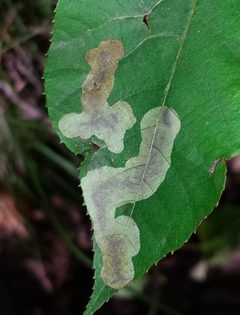
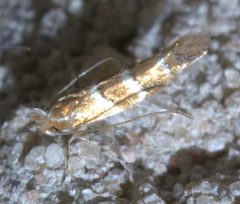
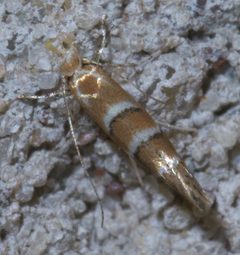
The combination of minute size (6–7 mm wingspan), golden-brown forewings with white fasciate markings, and association with Carya (hickory and pecan) foliage distinguishes this . may be separated from other Cameraria species by genitalia examination; the specific epithet caryaefoliella refers to the association. Larval mines are blotch-type on the upper leaf surface, with visible accumulation.
Images
Appearance
are minute with a wingspan of 6–7 mm. Forewings are narrow and , typical of the . Coloration includes golden-brown to ochreous ground color with distinct white markings, including a prominent fascia and spot. Hindwings are narrow and grayish. The exhibits the reduced venation and elongated wing shape characteristic of Gracillariidae.
Habitat
Deciduous forests and woodlands; orchards and suburban plantings where trees occur. Associated with riparian corridors and upland hardwood forests supporting Carya .
Distribution
Eastern North America: Ontario and Quebec (Canada); United States from New England (Vermont, Connecticut, New York, Pennsylvania) south to Florida and west to Texas, Illinois, Wisconsin, Kentucky, Alabama, and Georgia.
Seasonality
Three per year in the core of its range; active from spring through late summer with peaks corresponding to leaf flush on trees.
Diet
Larvae feed as leaf miners within leaves of Carya (hickories and pecan), including Carya illinoinensis (pecan). Specific feeding records on other Carya species are presumed but require confirmation.
Host Associations
- Carya illinoinensis - larval pecan
- Carya - larval -level association with hickories
Life Cycle
Three annually. deposited on leaf undersides. Larvae mine mesophyll tissue, creating upper-surface blotch mines with dispersed . occurs within the mine or in a silken cocoon on the leaf surface. emerge to mate and oviposit on new foliage.
Behavior
Larvae are endophytic leaf miners, feeding between leaf epidermal layers. are or , with weak typical of microlepidoptera. Mating and oviposition occur on foliage.
Ecological Role
As a herbivore, larvae contribute to leaf damage on Carya . and likely regulate . Mines may predispose leaves to secondary or premature abscission under high .
Human Relevance
Economic pest of pecan (Carya illinoinensis) in commercial orchards, where leaf mining reduces photosynthetic capacity and may affect nut development. Management in orchards may involve applications timed to larval establishment.
Similar Taxa
- Cameraria caryaeAlso associated with Carya; distinguished by genitalia and mine
- Phyllonorycter caryaecolaAnother gracillariid leafminer on Carya; creates lower-surface tentiform mines rather than upper-surface blotches
- Other Cameraria speciesMany occur on different ; host association and genitalia dissection required for definitive identification
More Details
Nomenclatural history
Originally described as Lithocolletis caryaefoliella by Clemens in 1859; transferred to Cameraria following taxonomic revision of Gracillariidae.
Observation frequency
Over 1,300 observations documented on iNaturalist, indicating relatively common occurrence within its range.