
Cameraria hamadryadella
(Clemens, 1859)
Solitary Oak Leafminer, Solitary Oak Leafminer Moth
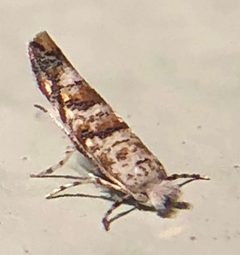
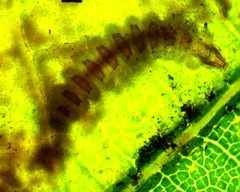
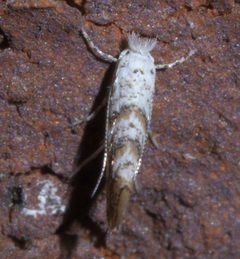
Cameraria hamadryadella is a small leaf-mining in the Gracillariidae, widely distributed across temperate North America. The larvae feed exclusively on oak (Quercus) , creating distinctive mines within leaves. are active in spring with typically two per year, though a facultative third generation may occur in warm years. are strongly influenced by plant , particularly the timing of autumn leaf fall, which can account for more than 50% of mortality in years with early leaf drop.
Pronunciation
How to pronounce Cameraria hamadryadella: /ˌkæməˈrɛərɪə ˌhæmədraɪəˈdɛlə/
These audio files are automatically generated. While they are not always 100% accurate, they are a good starting point.
Identification
The specific epithet 'hamadryadella' and 'solitary oak leafminer' distinguish this as an oak . Larval mines occur on Quercus species and can be identified by association with plant. are extremely small (6.5–8.5 mm wingspan) and require microscopic examination for definitive identification; they are active in spring with two per year. Vertical stratification within tree crowns—higher densities in lower crown—is a -level pattern that may aid detection.
Images
Habitat
Oak forests and woodlands. Larvae develop within leaves of oak trees (Quercus ). is vertically stratified within tree crowns, with higher densities on foliage in the lower crown. Larval survival is higher in shaded environments than in sunny conditions, though oviposition shows no discrimination between sun and shade foliage.
Distribution
Widely distributed in temperate North America. Documented from Canada (Québec, Manitoba, Ontario, British Columbia) and the United States (including Kentucky, Illinois, New York, Pennsylvania, Florida, Vermont, Maine, Michigan, Virginia, Ohio, Colorado, Texas, Connecticut, and Atlantic States).
Seasonality
are on wing in spring. Typically two per year; a facultative third generation has been observed in warm years with accelerated development. Ovipositing females are active after dark.
Diet
Larvae feed on oak (Quercus) , mining leaves from within. Documented species include Quercus alba, Q. bicolor, Q. coccinea, Q. ilicifolia, Q. lyrata, Q. macrocarpa, Q. marilandica, Q. prinoides, Q. prinus, Q. robur, Q. rubra, Q. stellata, and Q. velutina. Also recorded from Gaylussacia species.
Host Associations
- Quercus alba - larval white oak
- Quercus macrocarpa - larval bur oak
- Quercus rubra - larval northern red oak
- Quercus velutina - larval black oak
- Closterocerus tricinctus - eulophid ; exhibits -dependent foraging on leaf mines
Life Cycle
Multivoltine with typically two per year; facultative third generation possible in warm years with accelerated development. Larval development occurs as leaf miners within oak leaves. stage not explicitly documented in available sources.
Behavior
Females oviposit on oak foliage without discrimination between sun and shade environments, despite higher larval survival in shade. Oviposition activity occurs after dark. Females show limited movement into the upper tree crown from , , or resting sites in the lower crown, with depletion as they move upward; this behavioral pattern likely explains vertical stratification of . No oviposition preference detected between upper and lower crown foliage in laboratory tests.
Ecological Role
herbivore on oaks. Serves as for , including Closterocerus tricinctus. demonstrate strong coupling with host plant , making this a model organism for studying plant-herbivore interactions and the effects of climate variation on insect . Variation in autumn leaf fall timing may initiate population .
Similar Taxa
- Other Cameraria speciesCongeneric leaf-mining on oaks; require microscopic examination of genitalia or molecular analysis for definitive identification
- Other oak leaf-mining LepidopteraSimilar larval mining damage on Quercus; mine and characteristics needed for separation
More Details
Population Dynamics and Climate
The timing of autumn leaf fall is a critical driver of . Early leaf fall can cause more than 50% mortality, while late leaf fall reduces mortality and increases overwinter survival. Warm winters and springs can accelerate development and induce a facultative third . These factors may combine to initiate .
Parasitoid Interactions
The Closterocerus tricinctus exhibits complex -dependent foraging: it visits leaves with mine densities twice the average, but within-leaf foraging is inversely density-dependent due to self-interference and avoidance . Only 21% of visits to mines result in successful .
Vertical Stratification Mechanism
Higher densities in the lower tree crown appear to result from limited female movement upward from sites combined with depletion during ascent, rather than foliage quality differences, natural enemy gradients, or microclimatic effects. This 'movement and egg depletion hypothesis' is proposed as a model for studying vertical stratification in tree-feeding insects.
Sources and further reading
- BugGuide
- Wikipedia
- GBIF taxonomy match
- iNaturalist taxon
- NCBI Taxonomy
- Catalogue of Life
- Causes of vertical stratification in the density of Cameraria hamadryadella
- Density‐related foraging behaviour in Closterocerus tricinctus , a parasitoid of the leaf‐mining moth, Cameraria hamadryadella
- The effects of host plant phenology on the demography and population dynamics of the leaf‐mining moth, Cameraria hamadryadella (Lepidoptera: Gracillariidae)
- Effects of the light environment on oviposition preference and survival of a leaf‐mining moth, Cameraria hamadryadella (Lepidoptera: Gracillariidae), on Quercus alba L.