
Cameraria corylisella
(Chambers, 1871)
Hazel Blotchminer
Cameraria corylisella is a minute leaf-mining in the Gracillariidae, commonly known as the Hazel Blotchminer. It is restricted to eastern North America, where larvae create blotch mines in leaves of hornbeams, hazels, and hophornbeams ( Carpinus, Corylus, and Ostrya). are active in spring and early summer.

Pronunciation
How to pronounce Cameraria corylisella: //ˌkæməˈrɛəriə ˌkɔrɪlɪˈsɛlə//
These audio files are automatically generated. While they are not always 100% accurate, they are a good starting point.
Identification
Distinguished from other Cameraria by combination of plant association (Carpinus, Corylus, Ostrya) and geographic distribution. Larval mines are blotch-type (expanded, irregular patches) rather than linear, located on the upper leaf surface. require microscopic examination of genitalia for definitive identification; wing pattern alone is insufficient to separate from congeneric species.
Images
Appearance
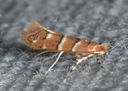
Very small with wingspan 6.5–7 mm. Forewings are narrow and elongated with characteristic patterning typical of Cameraria , including pale ground color with darker markings. Body is slender and compact, with long relative to body size. At rest, wings are held tent-like over the body.
Habitat
Deciduous forests and woodlands where trees occur. Found in mature and second-growth forests, forest edges, and occasionally suburban areas with native tree plantings. Host trees prefer mesic to moist, well-drained soils.
Distribution
Eastern North America: Canada (Manitoba, Ontario, Quebec) and United States (Connecticut, Illinois, Kentucky, Maine, New York, Vermont, Wisconsin). Distribution closely tracks that of its primary .
Seasonality
active in spring and early summer; larval mining occurs during growing season. Specific periods vary by latitude, with earlier in southern parts of range.
Diet
Larvae are leaf miners feeding internally on leaf tissue of Carpinus americana, Carpinus caroliniana, Corylus americana, and Ostrya virginica. do not feed.
Host Associations
- Carpinus americana - larval
- Carpinus caroliniana - larval
- Corylus americana - larval
- Ostrya virginica - larval
Life Cycle
Complete . laid on leaf surface. Larvae mine leaf mesophyll, creating blotch mines that expand as larvae grow. occurs within the mine or in soil. stage not definitively documented for this , but likely as pupa given patterns.
Behavior
Larvae are solitary leaf miners, each creating a single blotch mine. Mines begin as small spots and expand to irregular blotches 10–20 mm across. Larvae feed with side toward leaf surface, visible as dark specks within the translucent mine. are and , often found resting on foliage.
Ecological Role
Primary consumer of leaf tissue; minor herbivore of forest understory trees. Leaf mining damage is generally not severe enough to impact tree health. Serves as prey for and insectivorous birds.
Human Relevance
No significant economic or ecological impact. Occasionally noticed by gardeners or foresters due to visible leaf mines, but damage is cosmetic and does not require management. Provides an accessible example of leaf-mining insect for educational purposes.
Similar Taxa
- Cameraria hamadryadellaAlso mines oaks (Quercus), not Carpinus/Corylus/Ostrya; different association is primary separator
- Phyllonorycter speciesCreate tentiform mines with raised , whereas Cameraria creates flat blotch mines; different mine
- Other Cameraria speciesRequire genital dissection for definitive identification; plant and geographic range provide preliminary separation
More Details
Taxonomic note
Described by Chambers in 1871 from Kentucky. The specific epithet 'corylisella' refers to Corylus (hazel), one of the primary .
Mine characteristics
Mines are upper-surface blotches, often with multiple larvae per leaf but one larva per mine. is deposited in scattered grains throughout the mine rather than in discrete lines.