
Caloptilia vacciniella
(Ely, 1915)
Caloptilia vacciniella is a small leaf-mining in the Gracillariidae. The is known from eastern North America, with records from Quebec, Ontario, Pennsylvania, Maine, Michigan, and Massachusetts. Larvae are specialized feeders on Vaccinium species, including lowbush blueberry, highbush blueberry, and hillside blueberry.
Pronunciation
How to pronounce Caloptilia vacciniella: /kæloʊpˈtɪliə væksɪˈniɛlə/
These audio files are automatically generated. While they are not always 100% accurate, they are a good starting point.
Identification
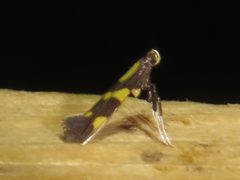
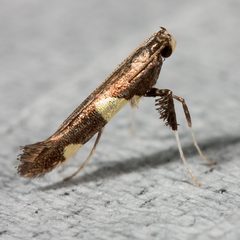
are small with characteristic resting posture typical of Caloptilia, with wings held roof-like over the body. The Caloptilia can be recognized by the distinctive way adults hold their wings at rest, creating a narrow, elongate profile. -level identification requires examination of genitalia or detailed wing pattern analysis; C. vacciniella is distinguished from by association with Vaccinium and geographic range.
Images
Habitat
supporting Vaccinium , including blueberry barrens, forest edges, and acidic uplands. The occurs in both natural and cultivated blueberry settings.
Distribution
Eastern North America: Canada (Quebec, Ontario) and United States (Pennsylvania, Maine, Michigan, Massachusetts).
Diet
Larvae feed on Vaccinium angustifolium (lowbush blueberry), Vaccinium corymbosum (highbush blueberry), and Vaccinium pallidum (hillside blueberry). do not feed.
Host Associations
- Vaccinium angustifolium - larval lowbush blueberry
- Vaccinium corymbosum - larval highbush blueberry
- Vaccinium pallidum - larval hillside blueberry
Life Cycle
Larvae mine leaves of plants, creating blotch mines. occurs within the mine or in a silken cocoon. are and attracted to ultraviolet light. Specific and number of per year are not documented.
Behavior
are attracted to blacklights and mercury vapor lights. Larvae are leaf miners, feeding internally within blueberry leaves.
Ecological Role
As a , larvae may reduce photosynthetic capacity of plants. The serves as prey for and .
Human Relevance
Minor potential pest of cultivated blueberries, though economic impact appears limited. The is more commonly encountered by lepidopterists during surveys than by agricultural professionals.
Similar Taxa
- Caloptilia blandellaAlso in Caloptilia and attracted to lights; distinguished by association (walnut for C. blandella versus Vaccinium for C. vacciniella) and wing pattern details requiring close examination
- Other Caloptilia speciesMany are superficially similar in size and resting posture; reliable identification requires genitalia dissection or association with documented plant