
Caloptilia triadicae
Davis, 2013
Chinese Tallow Leaf Miner
Caloptilia triadicae is a small in the Gracillariidae, described by Davis in 2013. It is a leaf-mining on Chinese tallow tree (Triadica sebifera), an plant in the southeastern United States. The is (non-native) in North America and has been investigated for its potential as a agent. Its seasonal abundance patterns and associations have been studied in Florida.
Pronunciation
How to pronounce Caloptilia triadicae: //ˌkæ.ləpˈtɪl.i.ə traɪˈæd.ɪˌsiː//
These audio files are automatically generated. While they are not always 100% accurate, they are a good starting point.
Identification
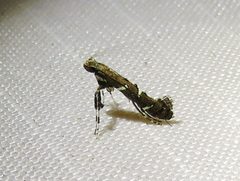
A small gracillariid with narrow, elongated wings typical of the Caloptilia. rest with wings folded roof-like over the body. Larvae produce characteristic blotch mines on leaves of Chinese tallow tree, with later instars often folding or rolling leaf edges. Specific diagnostic features for separating C. triadicae from require examination of genitalia or molecular analysis.
Images
Habitat
Associated with Chinese tallow tree (Triadica sebifera) in both natural and disturbed where this plant occurs. Found in wooded areas, riparian zones, and open fields where the tree has established.
Distribution
Southeastern United States: documented from Alabama, Florida, Georgia, Louisiana, and Mississippi. Native range presumably coincides with that of its plant in East Asia.
Seasonality
Seasonal abundance has been studied in Florida, indicating activity patterns tied to plant . are attracted to ultraviolet light sources during periods.
Diet
Larval feeding on leaf tissue of Chinese tallow tree (Triadica sebifera). Early instars are leaf miners; later instars may fold or roll leaves.
Host Associations
- Triadica sebifera - obligate larval Chinese tallow tree, in southeastern US; sole known in North America
Life Cycle
Complete with , larval, pupal, and stages. Larval development occurs within or on leaves of the plant. Specific details of site and voltinism not extracted from available sources.
Behavior
fly to ultraviolet light sources. Larvae exhibit leaf-mining in early instars, transitioning to leaf-folding or rolling in later development.
Ecological Role
Herbivore of Chinese tallow tree; potentially contributes to of this problematic plant. Subject to regulation by unspecified .
Human Relevance
Investigated as a potential agent for Chinese tallow tree, one of the most woody plants in the southeastern United States.
Similar Taxa
- Caloptilia blandellaAlso a Caloptilia found in North America, but associated with walnut (Juglans) rather than Chinese tallow; plant association is the primary distinguishing feature
- Other Caloptilia speciesMany are leaf miners on diverse plants; definitive identification requires examination of genitalia or host plant confirmation
Sources and further reading
- BugGuide
- GBIF taxonomy match
- iNaturalist taxon
- NCBI Taxonomy
- Catalogue of Life
- Bug Eric: Remembering National Moth Week 2018
- Bug Eric: It's National Moth Week Already?!
- Bug Eric: October 2018
- Host Range ofCaloptilia triadicae(Lepidoptera: Gracillariidae): An Adventive Herbivore of Chinese Tallowtree (Malpighiales: Euphorbiaceae)
- Seasonal Abundance of the Adventive Chinese Tallowtree HerbivoreCaloptilia triadicae(Lepidoptera: Gracillariidae) and Its Parasitoids
- Systematics and Biology ofCaloptilia triadicae(Lepidoptera: Gracillariidae), A New Species of Leaf-Mining Moth of the Invasive Chinese Tallow Tree(Triadica sebifera(L.) Euphorbiaceae)