
Caloptilia superbifrontella
(Clemens, 1860)
Witch-hazel Caloptilia
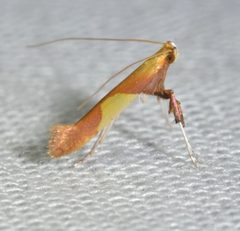
Caloptilia superbifrontella is a small in the Gracillariidae, commonly known as the Witch-hazel Caloptilia. The is restricted to eastern North America, with records from Canada (Québec and Nova Scotia) and the eastern and central United States. Larvae are leaf miners that feed exclusively on Hamamelis species, including witch-hazel and related shrubs.
Pronunciation
How to pronounce Caloptilia superbifrontella: //kæˌlɒpˈtɪliə suˌpɜːbɪˌfrɒnˈtɛlə//
These audio files are automatically generated. While they are not always 100% accurate, they are a good starting point.
Identification
The Caloptilia contains many similar small that require examination of genitalia or molecular analysis for definitive identification. C. superbifrontella can be distinguished from by its association with Hamamelis plants and its specific geographic distribution in eastern North America. The specific epithet 'superbifrontella' refers to distinctive frontal features, though practical field identification remains challenging without dissection.
Images
Appearance
Small with a wingspan of approximately 11 mm. have the characteristic slender body and narrow, often pointed wings typical of the Caloptilia. Specific coloration and pattern details for this are not well documented in available sources.
Habitat
Associated with deciduous forests and woodland edges where Hamamelis occur. plants include Hamamelis vernalis, Hamamelis virginica, and Hamamelis virginiana, which grow in moist to dry woodland .
Distribution
Eastern North America. Canada: Québec, Nova Scotia, Ontario. United States: Florida, Kentucky, Maine, Maryland, Michigan, New York, Vermont, Arkansas, West Virginia, and other Atlantic states.
Diet
Larvae feed exclusively on Hamamelis (Hamamelis vernalis, Hamamelis virginica, Hamamelis virginiana). They mine the leaves of their plant. feeding habits are not documented.
Host Associations
- Hamamelis vernalis - larval plant
- Hamamelis virginica - larval plant
- Hamamelis virginiana - larval plant
Life Cycle
Larvae are leaf miners that feed internally within Hamamelis leaves. Details of , timing, and number of per year are not documented in available sources.
Behavior
Larvae create leaf mines in plant foliage. are presumably and attracted to light, as is common in the Gracillariidae, though specific behavioral observations for this are not recorded.
Ecological Role
As a on Hamamelis, larvae contribute to nutrient cycling and may serve as prey for and other natural enemies. The is part of the specialized herbivore associated with witch-hazel.
Human Relevance
No direct economic importance. The may be encountered by naturalists and enthusiasts during surveys. Its presence indicates healthy of native Hamamelis plants.
Similar Taxa
- Caloptilia blandellaSimilar size and appearance; distinguished by plant association (walnut, Juglans) and different geographic distribution
- Other Caloptilia speciesMany are superficially similar; reliable identification requires examination of genitalia or plant confirmation