
Caloptilia sassafrasella
(Chambers, 1876)
Sassafras Caloptilia Moth
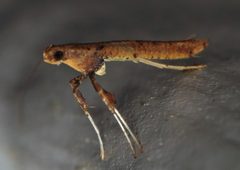
Caloptilia sassafrasella is a small in the Gracillariidae. The is a herbivore whose larvae mine leaves of sassafras trees (Sassafras spp.). Native to eastern North America, it has been documented from Canada south to Florida and west to Texas. are and attracted to light. The species was first described by Chambers in 1876.
Pronunciation
How to pronounce Caloptilia sassafrasella: /ˌkæləpˈtɪliə ˌsæsəˌfræsˈɛlə/
These audio files are automatically generated. While they are not always 100% accurate, they are a good starting point.
Identification
Small size (11 mm wingspan) and association with sassafras plants are primary clues. Distinguished from other Caloptilia by host specificity on Sassafras albidum and related species. Larval mining on sassafras leaves, followed by leaf-rolling in later instars, is diagnostic. may be separable from only by genitalia examination or ; external is subtle.
Images
Habitat
Deciduous forests and woodlands where sassafras trees occur. Found in natural stands and possibly suburban or rural areas with sassafras present. plant availability is the primary determinant.
Distribution
North America: Canada (Ontario); United States from Maine and Connecticut south to Florida and Georgia, west to Kentucky, Missouri, and Texas. Distribution corresponds closely to the native range of sassafras plants.
Seasonality
have been observed during summer months. National Week records from late July suggest peak adult activity in mid to late summer. Specific period not well documented.
Diet
Larvae feed exclusively on Sassafras albidum, Sassafras officinale var. albidum, and Sassafras sassafras (Lauraceae). Early instars are leaf miners; later instars feed within downward-rolled leaf edges. feeding habits unknown.
Host Associations
- Sassafras albidum - larval food plantprimary
- Sassafras officinale var. albidum - larval food plantrecorded
- Sassafras sassafras - larval food plantrecorded
Life Cycle
Complete with four stages: , larva, pupa, . Larvae progress through distinct feeding phases: initial leaf-mining instars followed by construction of a downward-rolled leaf shelter in later instars where feeding continues and presumably occurs. Specific details of egg placement, number of per year, and stage not documented.
Behavior
are and attracted to ultraviolet light sources. Larvae exhibit progressive behavioral change from internal leaf mining to external leaf rolling. The downward-rolled leaf shelter likely provides protection from and desiccation.
Ecological Role
Herbivore specializing on sassafras trees. As a and roller, larvae alter leaf tissue and may affect photosynthetic capacity of individual leaves, though impacts on trees are likely minimal. Serves as prey for including birds, spiders, and . Specific parasitoid associations not documented.
Human Relevance
No direct economic importance. Not considered a pest of ornamental or timber sassafras. Occasionally encountered by enthusiasts during blacklighting events. Contributes to biodiversity documentation through citizen science platforms such as iNaturalist and National Moth Week.
Similar Taxa
- Caloptilia blandellaCongeneric with similar size and ; distinguished by association with walnut (Juglans) rather than sassafras
- Other Caloptilia spp.Many in are morphologically similar and require plant association or genitalia examination for reliable identification; most specialize on different host plant
More Details
Taxonomic history
Described by V.T. Chambers in 1876, a prominent 19th-century American entomologist who described numerous North American microlepidoptera
Research needs
Detailed studies of , voltinism, and larval complexes are lacking for this