
Caloptilia murtfeldtella
(Busck, 1904)
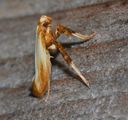
Caloptilia murtfeldtella is a small gracillariid known for its distinctive larval . The creates stem galls on Penstemon plants, with larvae developing inside individual galls before emerging through a specially prepared epidermal window. overwinter and have been recorded across multiple U.S. states and Canadian provinces. The species was named in honor of naturalist Mary Murtfeldt, who collected the .
Pronunciation
How to pronounce Caloptilia murtfeldtella: /kæˌlɒpˈtɪliə ˌmɜrtˌfɛldˈtɛlə/
These audio files are automatically generated. While they are not always 100% accurate, they are a good starting point.
Identification
Identification relies on association with plant galls and geographic distribution. The stem gall —low on the stem, with a circular epidermal window prepared by the larva—is characteristic. are small (18 mm wingspan) gracillariid ; precise diagnostic features for separating from are not documented in available sources. Larval presence confirmed by dissecting galls or observing the characteristic exit window.
Images
Habitat
Associated with Penstemon plants in open . Specific habitat requirements for not documented.
Distribution
United States: Missouri, Washington, California, Kentucky, Michigan, Ohio. Canada: Alberta, British Columbia, Ontario, Saskatchewan.
Seasonality
active in summer; larvae present in plant stems during growing season. overwinters in the adult stage.
Diet
Larvae feed on Penstemon hirsutus, Penstemon laevigatus, and Penstemon peckii (Plantaginaceae). feeding habits unknown.
Host Associations
- Penstemon hirsutus - larval larvae create stem galls
- Penstemon laevigatus - larval larvae create stem galls
- Penstemon peckii - larval larvae create stem galls
Life Cycle
laid on plant stems. Larvae induce stem galls and develop inside; one larva per gall regardless of gall number per stem. Full-grown larva chews exit tunnel through gall wall, leaving epidermal window, then spins cocoon anchored to gall base with upper end surrounding window. emerges through window. Overwinters as adult.
Behavior
Larvae are gall-formers with solitary occupancy of galls despite potential for multiple galls per stem. Larvae prepare precise exit architecture before . overwinter, suggesting late-season activity and spring pattern.
Ecological Role
As a gall-former, modifies plant stem tissue, potentially affecting plant growth and resource allocation. Specific ecological impacts not quantified.
Human Relevance
Named after naturalist Mary Murtfeldt, recognizing her contributions to entomological specimen collection. No economic importance documented.
Similar Taxa
- Other Caloptilia speciesMany Caloptilia are leaf miners rather than gall-formers; C. murtfeldtella distinguished by stem gall on Penstemon
- Other gracillariid gall-formers plant specificity and gall position (low on stem) with characteristic exit window distinguish this
More Details
Etymology
epithet honors Mary Murtfeldt (1839-1913), American naturalist and entomologist who collected the specimens used by August Busck for the original description in 1904.
Gall characteristics
Galls occur low on Penstemon stems. The larva's preparation of an exit window—chewing through almost the entire gall wall while preserving the outer as a visible circular mark—is a distinctive behavioral trait.