
Scopula lautaria
(Hübner, [1831])
Small Frosted Wave, small frosted wave moth
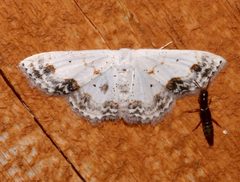
Scopula lautaria, commonly known as the small frosted wave , is a of geometrid moth described by Jacob Hübner in 1831. It is a member of the Geometridae, which includes the inchworm moths, and belongs to the Sterrhinae. The species is distributed across parts of North America, particularly in the southeastern United States.
Pronunciation
How to pronounce Scopula lautaria: /ˈskɒp.jʊ.lə lɔːˈtɛə.rɪə/
These audio files are automatically generated. While they are not always 100% accurate, they are a good starting point.
Identification
The small frosted wave can be distinguished from similar Scopula by its small size (15 mm wingspan), specific wing pattern elements, and geographic distribution. Within the Scopula, which contains many similar-looking species, precise identification requires examination of genitalia or detailed wing pattern analysis. It is smaller than Scopula limboundata (large lace-border moth), which has a wingspan of approximately 20–25 mm and more pronounced lace-like border patterns.
Images
Appearance
The small frosted wave has a wingspan of approximately 15 millimetres (0.59 inches). Like other members of the Scopula, typically exhibit a delicate, somewhat translucent wing appearance with subtle patterning. The 'frosted wave' suggests a pale, slightly iridescent or powdery wing surface with wavy transverse lines.
Habitat
Specific preferences for Scopula lautaria are not well documented in available sources. Based on its distribution in the southeastern United States and the general of the Scopula, it likely occurs in open, dry to mesic habitats including grasslands, open woodlands, and forest edges where larval plants grow.
Distribution
Scopula lautaria is found in North America, with confirmed records from Florida, Georgia, Mississippi, South Carolina, and Texas. The distribution appears centered in the southeastern United States, though the full extent of its range may be broader.
Seasonality
period is not precisely documented in available sources. Based on related Scopula and general geometrid in the southeastern United States, adults likely fly from late spring through summer, with possible multiple .
Host Associations
- Larval host plants - larval food sourceSpecific plants for Scopula lautaria are not documented in available sources. Larvae of Scopula generally feed on a variety of low-growing plants, herbs, and shrubs.
Life Cycle
The of Scopula lautaria follows the typical geometrid pattern: , larva (inchworm/cankerworm), pupa, and . Larvae possess only two or three pairs of at the end, resulting in the characteristic looping or 'inching' locomotion that gives the its . Specific details regarding number of per year, stage, or developmental duration are not available.
Behavior
are likely or , as is typical for most geometrid . They may be attracted to light. Larvae are cryptic feeders on vegetation, using their characteristic looping movement to navigate plants.
Ecological Role
As a herbivorous insect, the larvae contribute to nutrient cycling and serve as prey for various including birds, , and other arthropods. may serve as minor if they visit flowers for nectar, though this has not been specifically documented for this .
Human Relevance
Scopula lautaria has no documented economic importance. It is not known to be a pest of agricultural or ornamental plants. The may be encountered by enthusiasts and contributes to regional biodiversity.
Similar Taxa
- Scopula limboundataSimilar size and appearance, but larger (20–25 mm wingspan) with more pronounced lace-like wing borders; occurs in eastern North America
- Other Scopula speciesMany Scopula are morphologically similar and require detailed examination or genitalia dissection for reliable identification
More Details
Taxonomic history
Described by Jacob Hübner in 1831, placing it among the earlier described North American geometrid . The specific epithet 'lautaria' is of unclear etymology.
Conservation status
No specific conservation status has been assigned to this . It appears to be relatively common within its documented range based on iNaturalist observation records.