
Rheumaptera
Hübner, 1822
Spear-marked black moths
Species Guides
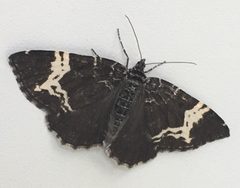
5- Rheumaptera hastata(Spear-marked Black Moth)
- Rheumaptera meadii(Barberry Geometer Moth)
- Rheumaptera prunivorata(cherry scallop shell)
- Rheumaptera subhastata(white-banded black moth)
- Rheumaptera undulata(scallop shell)
Rheumaptera is a of geometrid moths in the Larentiinae, established by Jacob Hübner in 1822. The genus contains distributed across the Holarctic region and South America. Best-studied species include R. hastata in North America and R. mochica in South America. are typically active in summer months, with larvae feeding externally on leaves of woody plants.
Pronunciation
How to pronounce Rheumaptera: //ɹiːəˈmæptərə//
These audio files are automatically generated. While they are not always 100% accurate, they are a good starting point.
Images
Habitat
Terrestrial environments with plants; includes subarctic, , and temperate regions. R. hastata occurs in Interior Alaska among willows, birches, and alders. R. mochica inhabits western Andean slopes in southern Peru and Chile.
Distribution
Holarctic region and western South America. North American records include Alaska and Vermont. European distribution includes Denmark, Norway, and Sweden. South American distribution includes southern Peru and Chile.
Seasonality
of R. hastata emerge in late June to early July in Interior Alaska. Single per year ().
Diet
Larvae feed externally on leaves of woody plants. R. hastata larvae feed on Salix spp. (willows), Betula nana (dwarf birch), Alnus crispa (green alder), and Betula papyrifera (paper birch). R. mochica larvae feed on Senna birostris var. arequipensis (Fabaceae).
Host Associations
- Salix spp. - larval willows
- Betula nana - larval dwarf birch
- Alnus crispa - larval green alder
- Betula papyrifera - larval paper birch; preferred oviposition and feeding site for R. hastata
- Senna birostris var. arequipensis - larval Fabaceae; for R. mochica
Life Cycle
(one per year). Overwinters as . Eggs laid singly or in small clusters on plant leaves. Larva progresses through five instars, feeding externally on leaves. occurs in soil or leaf litter.
Behavior
Males of R. hastata exhibit wing-fanning and when exposed to female-produced . Larvae feed externally on leaves rather than mining or boring.
Ecological Role
Herbivore; leaf-feeding larvae on woody plants in subarctic, , and temperate .
Similar Taxa
- R. subhastataCo-occurs with R. hastata in North America; distinguished by and larval characteristics per identification keys
- R. affirmataSister to R. mochica based on mitochondrial analysis; genitalia differs
More Details
Taxonomic history
R. mochica was described from Peru in 1904 and remained unreported for over a century until rediscovered in Chile. A lectotype was designated for the original name Calocalpe mochica. Molecular analysis shows 3.6–3.8% K2P divergence between R. mochica and R. affirmata.
Host plant quality effects
In R. hastata, larval development rate and survival decrease when fed foliage from birch trees subjected to repeated defoliation for 2–3 years. Food quality of larval plants affects female oviposition, , and viability.
Sources and further reading
- BugGuide
- Wikipedia
- GBIF taxonomy match
- iNaturalist taxon
- NCBI Taxonomy
- Catalogue of Life
- THE RHEUMAPTERA OF NORTH AMERICA (LEPIDOPTER A: GEOMETRIDAE)
- Biology and Behavior of the Spear-Marked Black Moth, Rheumaptera hastata, in Interior Alaska1
- Behavioral Responses of the Spear-Marked Black Moth, Rheumaptera hastata,1 to a Female-Produced Sex Pheromone2
- INFLUENCE OF HOST FOLIAGE ON DEVELOPMENT, SURVIVAL, FECUNDITY, AND OVIPOSITION OF THE SPEAR-MARKED BLACK MOTH, RHEUMAPTERA HASTATA (LEPIDOPTERA: GEOMETRIDAE)
- The South American moth Rheumaptera mochica (Dognin, 1904) (Lepidoptera, Geometridae, Larentiinae) rediscovered after more than a century of anonymity