
Rheumaptera undulata
(Linnaeus, 1758)
scallop shell
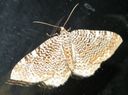
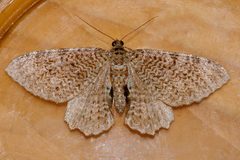
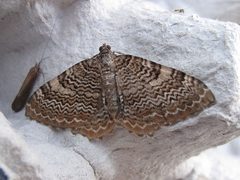
Rheumaptera undulata, commonly known as the scallop shell, is a geometrid with a wingspan of 25–30 mm. The is characterized by pale forewings with numerous darker, wavy, evenly spaced crosslines and a scalloped fringe on the outer margin. It was first described by Carl Linnaeus in 1758 and occurs across the and North America. are active from late May to August in Europe, with one per year. The larvae feed on a diverse range of woody plants including birch, willow, Vaccinium species, aspen, and others.
Pronunciation
How to pronounce Rheumaptera undulata: //rɛʊˈmæptəra ˌʌndʊˈleɪtə//
These audio files are automatically generated. While they are not always 100% accurate, they are a good starting point.
Identification
Distinguished from similar geometrid moths by the combination of pale ground color with numerous wavy crosslines and the distinctive scalloped fringe on the outer wing margin. The hindwings are paler than the forewings, which helps separate it from some related . Larval shelters made from single spun leaves are also characteristic.
Images
Habitat
Light quarry and floodplain forests, bushy forest edges, gardens, and park landscapes. In the Alps, occurs up to elevations of 1500 metres.
Distribution
Most of the and North America. Specific records include Alberta, Manitoba, and Saskatchewan in Canada.
Seasonality
One per year. on wing from end of May to August in Europe. Larvae present in August and September.
Diet
Larvae feed on birch (Betula verrucosa, B. pubescens), Vaccinium (V. myrtillus, V. uliginosum), willow species (Salix myrtilloides, S. caprea, S. aurita, S. cinerea, S. myrsinifolia, S. phylicifolia), aspen (Populus tremula), Populus balsamifera, Berberis vulgaris, Ribes alpinum, Spiraea salicifolia, rowan (Sorbus aucuparia), Elaeagnus commutata, and Myrica gale.
Host Associations
- Betula verrucosa - larval food plant
- Betula pubescens - larval food plant
- Vaccinium myrtillus - larval food plant
- Vaccinium uliginosum - larval food plant
- Salix myrtilloides - larval food plant
- Salix caprea - larval food plant
- Salix aurita - larval food plant
- Salix cinerea - larval food plant
- Salix myrsinifolia - larval food plant
- Salix phylicifolia - larval food plant
- Populus tremula - larval food plant
- Populus balsamifera - larval food plant
- Berberis vulgaris - larval food plant
- Ribes alpinum - larval food plant
- Spiraea salicifolia - larval food plant
- Sorbus aucuparia - larval food plant
- Elaeagnus commutata - larval food plant
- Myrica gale - larval food plant
Life Cycle
Overwinters as pupa. One per year. emerge late May through August. Larvae active August through September.
Behavior
Larvae construct solitary shelters by spinning single leaves or small clusters of shoot tips together with silk. are and attracted to light.
Ecological Role
Larval herbivore on woody plants. Role in as prey for birds, bats, and other ; specific not documented.
Human Relevance
Minor significance. Occasionally found in gardens and parks where plants occur. Not known as an agricultural or forestry pest.
Similar Taxa
- Other Rheumaptera speciesSimilar wing patterns and body form; distinguished by specific arrangement and spacing of crosslines and fringe characteristics
- Other Larentiinae mothsSimilar overall geometrid ; R. undulata distinguished by scalloped wing fringe and wavy crossline pattern
More Details
Subspecies
Rheumaptera undulata undulata; Rheumaptera undulata sajana Bryk, 1921
Historical note
First described by Carl Linnaeus in the 10th edition of Systema Naturae (1758), making it one of the earliest described geometrid moths