
Rheumaptera hastata
(Linnaeus, 1758)
Spear-marked Black Moth, Argent and Sable Moth
Rheumaptera hastata is a day-flying geometrid with distinctive black and white coloration. It is widely distributed across the Holarctic region, with well-studied in interior Alaska. The is , with active from early June to mid-July. Larvae are external leaf feeders with strong preferences, particularly for paper birch.
Pronunciation
How to pronounce Rheumaptera hastata: /raɪˈmæptərə hæˈsteɪtə/
These audio files are automatically generated. While they are not always 100% accurate, they are a good starting point.
Identification
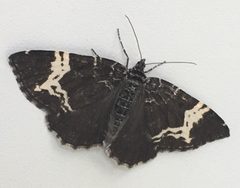
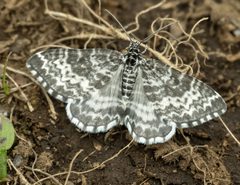
Distinguished from similar geometrid moths by its striking black and white wing pattern and activity. The 'spear-marked black ' refers to specific wing markings. Larvae can be identified by their cryptic coloration and habit of resting along leaf midribs.
Images
Appearance
Distinctive black and white coloration. have contrasting black and white wing patterns that give the its 'argent and sable' (heraldic terms for silver/white and black). Larvae are cryptically colored and rest along leaf midribs.
Habitat
Wetlands, hillsides, and forested areas with deciduous plants. In Alaska, found in interior forest with stands of paper birch, aspen, willow, and alder.
Distribution
Holarctic distribution. Present in North America (including interior Alaska), and Europe (including Belgium).
Seasonality
emerge in early June and are present until mid-July. One per year ().
Diet
Folivorous. Larvae feed externally on leaves of deciduous trees and shrubs. Feeding intensity is approximately 40% higher on paper birch foliage compared to other plants.
Host Associations
- Betula papyrifera - larval Paper birch; preferred with highest oviposition preference and larval feeding intensity
- Populus tremuloides - larval Quaking aspen
- Salix alaxensis - larval Feltleaf willow
- Salix scouleriana - larval Scouler willow
- Alnus crispa - larval Green alder
- Alnus tenuifolia - larval Thinleaf alder
- Myrica gale - larval Bog myrtle; mentioned in European
Life Cycle
(one per year). laid singly or in small groups on plant leaves. Larvae have five instars and feed externally on leaves. occurs in soil. in early June, presence until mid-July.
Behavior
Day-flying . Larvae exhibit ballooning : dropping from foliage on silk threads to escape or adverse conditions. Females preferentially oviposit on paper birch over other available plants. Male moths exhibit attraction responses to female-produced .
Ecological Role
Herbivore and defoliator of deciduous trees and shrubs in forest . Can contribute to defoliation pressure on birch trees, particularly when plants are stressed by repeated defoliation events.
Human Relevance
Subject of entomological research on plant interactions, , and insect-plant . Not a significant agricultural or forestry pest, though larval feeding can contribute to defoliation of ornamental and native birch trees.
Similar Taxa
- Other Rheumaptera speciesSimilar -level characteristics; distinguished by specific wing pattern and
- Other Geometridae-level resemblance; R. hastata distinguished by bold black-and-white coloration and day-flying habit
More Details
Pheromone biology
Females produce a that elicits characteristic attraction responses in males. This has been studied using synthetic compounds.
Host quality effects
Food quality of larval plants affects oviposition , , and viability. Repeated defoliation of birch trees for 2-3 years reduces larval development rate and survival.
Sources and further reading
- BugGuide
- GBIF taxonomy match
- iNaturalist taxon
- NCBI Taxonomy
- Catalogue of Life
- Forgotten tropical plants rediscovered after 100+ years
- A fly with a golden touch? Mydas fly, Mydas clavatus — Bug of the Week
- Biology and Behavior of the Spear-Marked Black Moth, Rheumaptera hastata, in Interior Alaska1
- Behavioral Responses of the Spear-Marked Black Moth, Rheumaptera hastata,1 to a Female-Produced Sex Pheromone2
- INFLUENCE OF HOST FOLIAGE ON DEVELOPMENT, SURVIVAL, FECUNDITY, AND OVIPOSITION OF THE SPEAR-MARKED BLACK MOTH, RHEUMAPTERA HASTATA (LEPIDOPTERA: GEOMETRIDAE)