
Dysstroma citrata
(Linnaeus, 1761)
Dark Marbled Carpet, Northern Marbled Carpet
A Holarctic geometrid with highly variable forewing coloration ranging from whitish to dark brown or black. are active in mid-summer. The occupies mountainous and wetland across a broad latitudinal range from the Arctic to temperate zones.
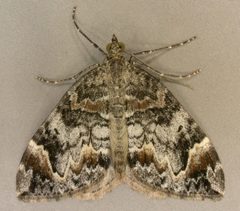
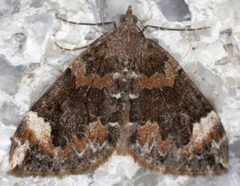
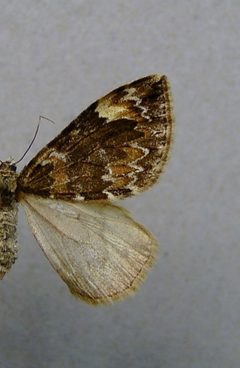
Pronunciation
How to pronounce Dysstroma citrata: /dɪsˈstroʊmə sɪˈtreɪtə/
These audio files are automatically generated. While they are not always 100% accurate, they are a good starting point.
Identification
Distinguished from the very similar Dysstroma truncata by the protruding postmedial line on the forewings, which typically extends to or interrupts the postdiscal wavy line. Forewing coloration is extremely variable and not reliable for identification. Examination of genitalia may be required for definitive separation from .
Images
Habitat
Mountainous areas, wetlands, mountain forests, and bushy slopes. Recorded at elevations up to approximately 2,400 meters in the Alps.
Distribution
Holarctic: Europe (absent from Portugal, Mediterranean islands, and Greece), through temperate Asia to northwest China, Mongolia, Russian Far East, and Japan. Northern limit: Scandinavia to Lapland, Iceland, and Faroe Islands. North America: Alaska and Newfoundland south to New England and California. Also reported from India.
Seasonality
on wing July to August.
Diet
Larvae feed on Vaccinium myrtillus, Vaccinium uliginosum, Aster tripolium, Alnus, and Salix.
Host Associations
- Vaccinium myrtillus - larval foodplant
- Vaccinium uliginosum - larval foodplant
- Aster tripolium - larval foodplant
- Alnus - larval foodplant
- Salix - larval foodplant
Life Cycle
Complete : , larva, pupa, . Pupae overwinter. Adults emerge mid-summer.
Similar Taxa
- Dysstroma truncataExtremely similar in appearance; distinguished by wing pattern details, particularly the postmedial line configuration
More Details
Subspecies
Four recognized: D. c. citrata; D. c. katshadalarium (Magadan, Kamchatka, Komandor Island, northern Kurils); D. c. nyiwonis; D. c. glacialis