
Eupithecia anticaria
Walker, 1862
pug moth
Eupithecia anticaria is a small in the Geometridae, first described by Francis Walker in 1862. It is widely distributed across North America, from eastern Canada to the western United States. The has a wingspan of approximately 18 mm and is active as an from May to July. It has been documented visiting apple flowers, contributing to pollination services.
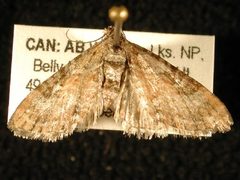

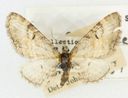
Pronunciation
How to pronounce Eupithecia anticaria: /juːpɪˈθiːʃiə ænˈtɪkəriə/
These audio files are automatically generated. While they are not always 100% accurate, they are a good starting point.
Identification
Members of the Eupithecia, commonly known as 'pugs,' are recognized by their narrow wings and unique resting posture. Eupithecia anticaria can be distinguished from other Eupithecia by its geographic distribution and period from May to July. Positive identification to species level typically requires examination of genitalic characters, as many Eupithecia species are morphologically similar and cannot be reliably separated by external appearance alone.
Images
Appearance
Small with a wingspan of approximately 18 mm. As a member of the Eupithecia, it possesses narrow wings and exhibits the characteristic resting posture typical of 'pug' moths, with wings held flat or slightly folded. Specific coloration and pattern details for this are not documented in the provided sources.
Habitat
Found in diverse across its broad North American range, including coniferous and mixed forests. Observations have been recorded at elevations of approximately 7,000 feet in dry, mixed conifer forest with oaks. The has been documented visiting apple orchards, indicating adaptability to anthropogenic environments.
Distribution
Transcontinental North American distribution. Found from eastern Newfoundland and Labrador across Canada to western British Columbia. Southern range extends to northern New Mexico and Apache and Coconino counties in Arizona. Documented presence in Canadian provinces including Alberta, Manitoba, and Saskatchewan, and in the United States including Vermont.
Seasonality
are on wing from May to July. The period is , with a single per year.
Life Cycle
Complete with , larva, pupa, and stages. Larval plants and detailed are not documented for this . As with other Eupithecia species, larvae are likely foliage feeders, but specific host associations remain unverified.
Behavior
, attracted to artificial light sources. Has been observed visiting apple flowers at night, contributing to pollination. are active during the evening and night hours.
Ecological Role
Documented as a of apple flowers. A 2021 study in the Journal of Economic Entomology recorded Eupithecia visiting apple blossoms, demonstrating that this and other nocturnal insects provide valuable pollination services comparable to daytime pollinators. As a member of the Geometridae , larvae likely function as herbivores in terrestrial , though specific ecological impacts are unstudied.
Human Relevance
Contributes to pollination of apple crops, providing services that benefit agricultural production. No other documented economic or cultural significance.
Similar Taxa
- Other Eupithecia speciesMany Eupithecia share narrow wings, small size, and similar resting postures. Most require dissection of genitalia for definitive identification.
- Other Geometridae (inchworm moths) members share the characteristic larval locomotion (looping) and , but Eupithecia is distinguished by its narrow wings and 'pug' resting posture.
More Details
Taxonomic history
First described by Francis Walker in 1862. The has remained in the Eupithecia without significant taxonomic revision.
Research significance
Featured in a 2021 study on apple pollination, highlighting the underappreciated role of in agricultural . The study found that nocturnally pollinated fruit achieved similar seed set to diurnally pollinated fruit, demonstrating functional equivalence of night-flying .