
Synchlora frondaria
Guenée, [1858]
southern emerald, wavy-lined emerald
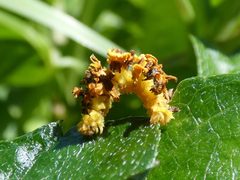
Synchlora frondaria, commonly known as the southern emerald, is a of emerald moth in the Geometridae. The species is notable for its remarkable larval camouflage , in which caterpillars decorate their bodies with plant material from their plants. This self-decoration, combined with phenotypic plasticity in coloration, creates a 'double cloak of invisibility' that allows larvae to blend effectively into diverse backgrounds. The species occurs across a broad geographic range including the Caribbean, Central America, North America, and South America.
Pronunciation
How to pronounce Synchlora frondaria: /sɪŋˈklɔːrə frɒnˈdɛəriə/
These audio files are automatically generated. While they are not always 100% accurate, they are a good starting point.
Identification
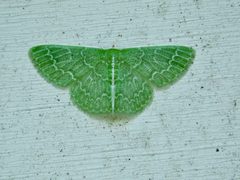
are recognized by their emerald green coloration and wavy wing patterns typical of Synchlora . Larvae are most readily detected by the presence of (excrement) on flower , or by observing small clusters of plant debris that move with a distinctive 'herky-jerky waltz' motion. The combination of self-decoration and phenotypic plasticity in larval coloration distinguishes this species from other geometrid caterpillars. Final instar larvae may be distinguished from the widespread S. aerata by geographic location and plant associations in areas where ranges overlap.
Images
Habitat
Occurs in diverse supporting its plants, including meadows, gardens, prairies, and open woodlands. Larval habitat is determined by host plant distribution, which includes various flowering herbs and shrubs.
Distribution
Broadly distributed across the Caribbean, Central America, North America, and South America. In North America, occurs from the southeastern United States through Central America and into South America.
Seasonality
activity period varies by region. In temperate North America, adults are active primarily during the warmer months. Larvae have been observed in late summer and early autumn in the northern parts of the range.
Diet
Larvae are herbivorous, feeding on a variety of flowering plants. Documented plants include: chrysanthemums, ageratum, aster, black-eyed Susan, boneset, coreopsis, daisy, goldenrod, Joe Pye weed, ragweed, raspberry, rose, sage, St. John's wort, yarrow, Heterotheca subaxillaris (camphorweed), camara (lantana), and Bejaria racemosa.
Host Associations
- Heterotheca subaxillaris - larval Asteraceae; larvae showed highest on this
- Lantana camara - larval Verbenaceae; supported high relative growth rates
- Bejaria racemosa - larval Ericaceae; lower relative growth rates and compared to other
- Chrysanthemum - larval Asteraceae
- Coreopsis - larval Asteraceae
- Solidago - larval Asteraceae; goldenrod
- Rubus - larval Rosaceae; raspberry
- Rosa - larval Rosaceae; rose
Life Cycle
Complete with , larva, pupa, and stages. Larvae progress through multiple instars, with self-decoration becoming more pronounced in later instars. occurs in a cocoon or sheltered location. The adult emerges as a fully winged .
Behavior
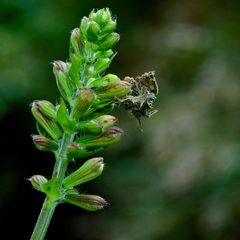
Larvae exhibit a distinctive self-decoration , actively gathering and attaching pieces of vegetation, flower petals, and other plant material to their bodies using silk. This creates a mobile camouflage that matches the local substrate. Larvae also display a characteristic swaying motion when at rest, enhancing the illusion of being plant debris moved by wind. The demonstrates phenotypic plasticity in larval coloration, with diet-induced changes in pigmentation that further enhance . are and attracted to light.
Ecological Role
Larvae function as herbivores in diverse plant . Their specialized camouflage represents an elaborate anti- defense that reduces pressure. The contributes to pollination as visit flowers for nectar.
Human Relevance
Occasionally encountered in gardens and ornamental plantings where larvae may feed on cultivated flowers such as chrysanthemums. Generally not considered a significant pest due to its cryptic nature and typically low densities. Valued by naturalists and photographers for its remarkable larval camouflage.
Similar Taxa
- Synchlora aerataWavy-lined emerald; widespread in eastern North America with similar larval decoration . and larvae are very similar in appearance, requiring geographic or plant information for reliable separation in areas of sympatry.
- Other Synchlora speciesMultiple in the share the characteristic emerald green coloration and larval self-decoration . Species-level identification often requires examination of genitalia or geographic range information.
- Chlorochlamys chloroleucariaRaspberry looper; another geometrid with green coloration, but lacks the distinctive larval decoration of Synchlora.
Misconceptions
Larvae are frequently overlooked or mistaken for plant debris due to their effective camouflage, leading to underestimation of their abundance. The swaying of larvae is sometimes misinterpreted as wind movement rather than active anti- behavior.
More Details
Research significance
S. frondaria has been studied as a model organism for understanding the evolution and mechanisms of . Research has demonstrated that larvae exhibit both phenotypic plasticity in body coloration and behavioral plasticity in decoration patterns in response to different plants, representing a 'double cloak of invisibility.'
Larval decoration mechanism
Larvae use silk to attach plant material to specialized structures on their bodies. The decoration is not random but appears to be actively selected to match the visual properties of the substrate. This is maintained across multiple host plant , though the specific materials used vary.
Subspecies
Two are recognized: Synchlora frondaria avidaria Pearsall, 1917 and Synchlora frondaria denticularia Walker, 1861.
Sources and further reading
- BugGuide
- Wikipedia
- GBIF taxonomy match
- iNaturalist taxon
- NCBI Taxonomy
- Catalogue of Life
- Mystery of the frass revealed: Camouflaged looper, Synchlora aerata — Bug of the Week
- Plants as camouflage - who thought of it first? Meet the camouflaged looper, Synchlora aerate — Bug of the Week
- Geometridae | Beetles In The Bush
- Lepidoptera | Beetles In The Bush | Page 7
- October | 2012 | Beetles In The Bush
- Archive — Bug of the Week
- The double cloak of invisibility: phenotypic plasticity and larval decoration in a geometrid moth, Synchlora frondaria , across three diet treatments