
Chlorochlamys chloroleucaria
(Guenée, [1858])
Blackberry Looper, Blackberry Looper Moth, Raspberry Looper
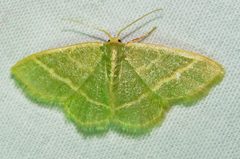
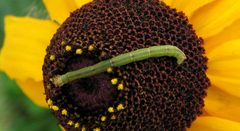
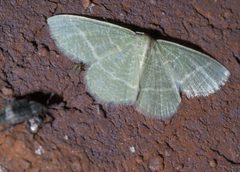
A small emerald geometrid widespread across eastern and central North America. are active from spring through fall with multiple . Larvae feed on blackberry and raspberry fruits as well as flower of numerous Asteraceae . The species has been documented on prairie dock (Silphium terebinthinaceum) and recently recorded on Eriogonum alatum (Polygonaceae), representing a range extension beyond its previously known associations.
Pronunciation
How to pronounce Chlorochlamys chloroleucaria: //klɒ.rəʊˈklæ.mɪs klɒ.roʊ.luˈkɛə.rɪə//
These audio files are automatically generated. While they are not always 100% accurate, they are a good starting point.
Identification
Distinguished from other small green geometrids by the combination of pale green ground color with fine, darker green linear patterning and relatively small size. The specific epithet 'chloroleucaria' (green-white) refers to the characteristic coloration. Similar in the Chlorochlamys and related emerald moths (such as Nemoria) may require examination of genitalia for definitive identification.
Images
Habitat
Open including prairies, glades, meadows, and woodland edges. Associated with areas supporting plants, particularly Rubus and diverse Asteraceae. Found in both dry and mesic conditions where composite flowers are abundant.
Distribution
Eastern and central North America: Nova Scotia south to Florida, west through Canada to Manitoba and Saskatchewan, west in the United States to the Rocky Mountains (Wyoming, Colorado), and south into Mexico and the Caribbean. A single 19th-century record from Great Britain (BMNH specimen) is considered an accidental introduction or mislabeling.
Seasonality
active April to November in southern portions of range; May to September in northern portions. At least two per year throughout most of range.
Diet
Larvae feed on fruit of Rubus (blackberries, raspberries) and flower of numerous Asteraceae including Achillea millefolium, Ambrosia, Aster, Chrysanthemum leucanthemum, Eupatorium perfoliatum, Gutierrezia species, Helenium autumnale, Helianthus, Parthenium hysterophorus, Rudbeckia hirta, Solidago species, Vernonia, Zinnia, Dianthus, Prunus pennsylvanica, Ceanothus, Myrica asplenifolia, and Apocynum androsaemifolium. Also recorded on Silphium terebinthinaceum (prairie dock) and Eriogonum alatum (winged buckwheat, Polygonaceae).
Host Associations
- Rubus - larval food plantfruit
- Silphium terebinthinaceum - larval food plantflower
- Eriogonum alatum - larval food plantdocumented range extension
- Achillea millefolium - larval food plantflower petals
- Helianthus - larval food plantflower petals
- Solidago - larval food plantflower petals
- Rudbeckia hirta - larval food plantflower petals
Life Cycle
Complete with multiple annually. laid on plants. Larvae feed on fruits or flower , with distinctive looping locomotion characteristic of geometrid caterpillars. presumably in soil or leaf litter. emerge and are active during extended period.
Behavior
Larvae exhibit typical geometrid 'looping' or 'inchworm' locomotion due to reduced number of . , attracted to light.
Ecological Role
Herbivore feeding on reproductive structures (fruits and flowers) of plants. May impact seed production in some host . Serves as prey for various and .
Human Relevance
Minor economic significance; larvae may damage blackberry and raspberry crops by feeding on developing fruits. Otherwise of limited direct importance to humans.
Similar Taxa
- Chlorochlamys triangularisSimilar small green geometrid in same ; requires genitalia examination for separation
- Nemoria speciesOther emerald moths with similar green coloration and pattern; distinguished by wing pattern details and structural characters
Sources and further reading
- BugGuide
- Wikipedia
- GBIF taxonomy match
- iNaturalist taxon
- NCBI Taxonomy
- Catalogue of Life
- Plantae | Beetles In The Bush | Page 7
- Insecta | Beetles In The Bush | Page 8
- Lepidoptera | Beetles In The Bush | Page 4
- Host Range Extension for <i>Chlorochlamys Chloroleucaria</i> (Geometrinae, Geometridae) to Include <i>Eriogonum Alatum</i> (Polygonaceae)