
Synchlora aerata
Fabricius, 1798
Wavy-lined Emerald, Camouflaged Looper
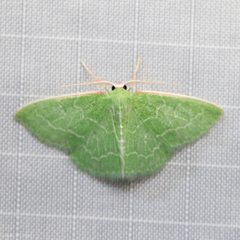
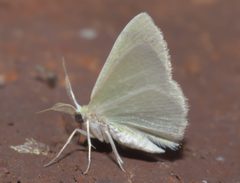
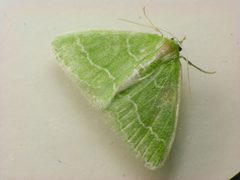
Synchlora aerata is a small emerald moth in the Geometridae, known for its remarkable larval of camouflaging itself with plant material. The caterpillar, called the camouflaged looper, attaches bits of flowers, leaves, or other plant tissue to spines on its back, rendering it nearly invisible among the vegetation it consumes. The exhibits characteristic wavy white lines across its emerald green wings. The is widespread across North America and has been documented feeding on numerous composite flowers and other plants.
Pronunciation
How to pronounce Synchlora aerata: /sɪŋˈklɔːrə aɪˈeɪrətə/
These audio files are automatically generated. While they are not always 100% accurate, they are a good starting point.
Identification
distinguished from other emerald moths (Geometrinae) by the fine, wavy white lines across the wings rather than straight or angled lines. The combination of small size, emerald green ground color, and wavy white patterning is diagnostic. Larva unmistakable due to its of attaching plant material to spines; no other North American caterpillar exhibits this precise form of active camouflage. When plant material is removed, the underlying green body with prominent dorsal spines distinguishes it from other loopers.
Images
Habitat
Found in diverse open including prairies, meadows, fields, gardens, and woodland edges. Associated with areas supporting its plants, particularly composites (Asteraceae) and other flowering plants. Larvae occur on the host plants themselves, often on flower where they attach bits of petals and other floral parts for camouflage.
Distribution
Widespread across most of North America. Documented from Canada (Alberta, Manitoba, Saskatchewan, southern Ontario, Newfoundland) throughout the United States including the Northeast, Midwest, Southeast, and Southwest. Three recognized with somewhat different ranges: S. a. aerata in the eastern and central U.S. and southern Ontario; S. a. albolineata from Newfoundland to Alberta and south to Minnesota, Wisconsin, New York, and New England; and S. a. liquoraria from California, Arizona, New Mexico north to British Columbia and Alberta.
Seasonality
active primarily in spring and summer, with timing varying by region. In the Northeast, adults fly from April through October with peak activity in summer. Larvae present during growing season when plants are available. Overwinters as partially grown larva, resuming feeding in spring before .
Diet
Larva feeds on composite flowers (Asteraceae) and various other flowering plants and shrubs. Recorded include Aster, Rudbeckia, Liatris, Solidago, Artemisia, Achillea, Rubus, chrysanthemum, daisy, goldenrod, ragweed, raspberry, rose, sage, St. John's wort, and yarrow. feeding habits not well documented but likely minimal or restricted to nectar.
Host Associations
- Aster - larval food plantNative composite, preferred
- Rudbeckia - larval food plantBlack-eyed Susan and
- Solidago - larval food plantGoldenrods, abundant late-season
- Artemisia - larval food plantSage, wormwood
- Achillea - larval food plantYarrow
- Rubus - larval food plantRaspberry, blackberry
- Chrysanthemum - larval food plantOrnamental cultivars
Life Cycle
Complete with four stages. laid on plant foliage or flowers. Larva passes through multiple instars, actively collecting and attaching plant material to spines for camouflage. Larva overwinters in partially grown state, protected by plant debris camouflage. Development resumes in spring; mature larva pupates in loose cocoon on host plant or in ground litter. emerges, mates, and females lay eggs on suitable host plants. Number of per year varies by region, with one to multiple possible in warmer areas.
Behavior
Larva exhibits unique active camouflage : uses silk to attach bits of plant tissue—flower petals, leaves, anthers, or other plant parts—to several large spines. This material is regularly replaced as the larva moves to new feeding sites, ensuring continuous matching with background vegetation. The camouflage serves dual purpose of concealment from visual (particularly birds) and possibly disruption of chemical detection by smaller predators and . Larva moves with characteristic looping gait common to Geometridae. When disturbed, may sway gently to enhance illusion of being a plant part moved by wind.
Ecological Role
Herbivore consuming flowers and foliage of various plants, with preference for composites. Serves as prey for birds, predatory insects, and despite camouflage defenses. Contributes to pollination indirectly through flower feeding and movement between plants. Larval camouflage represents notable example of plant-animal interaction where insect actively manipulates plant material for survival.
Human Relevance
Occasional minor pest of ornamental chrysanthemums and other garden flowers, though damage usually limited. More commonly appreciated for its remarkable camouflage , making it a subject of interest for naturalists, photographers, and educators. attracted to light. No significant economic impact documented.
Similar Taxa
- Other Synchlora speciesTwelve in North America; S. aerata is the only widespread eastern species. Other species restricted to Southeast or Southwest, requiring range and subtle wing pattern differences for separation.
- Other Geometrinae (emerald moths)Share green coloration but differ in wing pattern—most have straight or angled lines rather than wavy pattern of S. aerata. Size and precise line patterning distinguish .
- Other Geometridae larvae (inchworms/loopers)Share looping locomotion but lack the spines and active camouflage with plant material attachment. S. aerata larva unique in this regard.
More Details
Subspecies
Three recognized with somewhat different geographic ranges and subtle morphological differences: S. a. aerata (eastern and central), S. a. albolineata (northern), and S. a. liquoraria (western). Some sources treat these as separate or question their validity; further taxonomic study may be warranted.
Photographic challenge
The larva's camouflage presents significant photographic difficulty due to the three-dimensional projection of attached plant material in all directions, exceeding depth-of-field capabilities of standard macro equipment. Successful photography requires either focus stacking or accepting partial focus on either the subject or its adornments.
Sources and further reading
- BugGuide
- Wikipedia
- GBIF taxonomy match
- iNaturalist taxon
- NCBI Taxonomy
- Catalogue of Life
- Ants and Moths: Think Noon and Night! | Bug Squad
- Geometridae | Beetles In The Bush
- Lepidoptera | Beetles In The Bush | Page 7
- October | 2012 | Beetles In The Bush
- Archive — Bug of the Week
- Mystery of the frass revealed: Camouflaged looper, Synchlora aerata — Bug of the Week