
Synchlora
Guenée, [1858]
Emerald moths, Wavy-lined emeralds
Species Guides
12- Synchlora aerata(Wavy-lined Emerald)
- Synchlora aerata-frondaria(Wavy-lined Emerald)
- Synchlora bistriaria(oblique-striped emerald)
- Synchlora cupedinaria(Brown-bordered Emerald)
- Synchlora faseolaria(emerald moth)
- Synchlora frondaria(southern emerald)
- Synchlora graefiaria
- Synchlora herbaria(White-dotted Emerald)
- Synchlora irregularia(emerald moth)
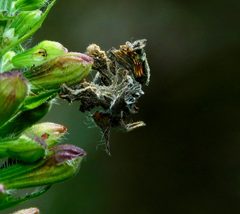
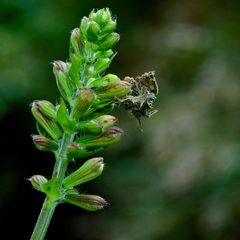
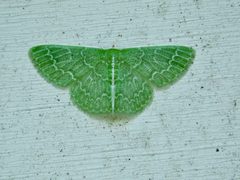
Synchlora is a of emerald moths in the Geometridae, characterized by with leaf-green wings and larvae that exhibit remarkable camouflage . Larvae actively adorn their bodies with pieces of plants, creating a 'double cloak of invisibility' that makes them nearly indistinguishable from their surroundings. The genus name derives from Greek 'syn-' (with) and 'chlor' (green), referencing the green coloration of adults. Twelve occur in North America, with S. aerata being the most widespread in the eastern United States.
Pronunciation
How to pronounce Synchlora: //sɪnˈklɔːrə//
These audio files are automatically generated. While they are not always 100% accurate, they are a good starting point.
Identification
can be recognized by their emerald green coloration and wavy wing lines, though -level identification often requires genitalia examination. Larvae are identified by their unique decorating —actively attaching plant fragments to their bodies with silk—and their presence on specific plants. The decorated appearance is distinctive; larvae resemble small clusters of plant debris or flower parts rather than typical caterpillars. When disturbed, larvae may sway back and forth, enhancing the illusion of plant parts moving in wind.
Images
Habitat
inhabit areas with abundant flowering vegetation. Larvae occur on a variety of plants including gardens, meadows, and natural areas with diverse flowering flora. They have been documented in dry-mesic upland deciduous forest, prairies, and disturbed with flowering plants.
Distribution
occurs across North America with approximately 12 . S. aerata is widespread in the eastern United States. Other species occur in the southeastern U.S. and southwestern regions. Records exist from Vermont south to Florida and west across the Great Plains. The Mississippi Lowlands of southeastern Missouri represent a biogeographically significant area for the genus.
Seasonality
are active during spring and summer months. Larvae are present during growing season when plants are in flower. In Missouri, late April through September activity has been documented. Specific timing varies by and latitude.
Diet
Larvae are herbivorous, feeding on flowers and foliage of diverse plants including: chrysanthemums, goldenrod (Solidago), daisies, asters, black-eyed Susan, boneset, coreopsis, Joe Pye weed, ragweed, raspberry, rose, sage, St. John's wort, yarrow, ageratum, mints, and mums. They show phenotypic plasticity in coloration based on diet.
Life Cycle
Complete : , larva, pupa, . Larvae progress through multiple instars, with decorating present throughout larval development. occurs in a cocoon. Adults emerge to mate and oviposit on plants.
Behavior
Larvae exhibit unique self-decorating camouflage , actively attaching plant fragments to their bodies using silk. This behavior is phenotypically plastic—larvae adjust their decoration to match current plant. When moving between feeding sites, larvae perform a characteristic 'herky-jerky waltz' and may sway to simulate plant movement in wind. are and attracted to light.
Ecological Role
Larvae serve as herbivores in flowering plant . Their cryptic makes them difficult prey for visual . They contribute to pollination dynamics through their association with diverse flowering plants. may serve as prey for predators and as minor .
Human Relevance
Larvae occasionally damage ornamental flowers including chrysanthemums and garden plantings, though they are generally not considered significant pests. Their remarkable camouflage makes them subjects of interest for natural history observation and photography. The has been featured in educational materials about insect camouflage and .
Similar Taxa
- Other Geometrinae (emerald moths)Similar green coloration, but Synchlora distinguished by wavy wing lines and larval decorating ; other emerald moths lack the characteristic larval camouflage strategy
- Other Geometridae larvae (inchworms/loopers)Similar body form and locomotion, but Synchlora larvae uniquely distinguished by active decoration with plant materials; other geometrid larvae may be cryptically colored but do not attach foreign materials to their bodies
- Psychidae (bagworm larvae)Both use plant materials for protection, but bagworms construct permanent portable cases of woven silk and plant material, while Synchlora larvae attach individual plant fragments directly to their bodies without a constructed case
More Details
Etymology
The name comes from Greek 'syn-' meaning 'with' and 'chlor' meaning 'green', referencing the characteristic leaf-green wing coloration of .
Research significance
Synchlora , particularly S. frondaria, have been studied as models for phenotypic plasticity and camouflage evolution. Research demonstrates that larvae show diet-induced plasticity in both coloration and decorating , representing a 'double cloak of invisibility' combining structural and color camouflage.
Photographic challenges
The very adaptations that make Synchlora larvae remarkable— their three-dimensional plant decorations—create significant challenges for macrophotography, as the projecting plant fragments exceed depth-of-field capabilities of standard macro lenses.
Sources and further reading
- BugGuide
- Wikipedia
- GBIF taxonomy match
- iNaturalist taxon
- NCBI Taxonomy
- Catalogue of Life
- Mystery of the frass revealed: Camouflaged looper, Synchlora aerata — Bug of the Week
- Plants as camouflage - who thought of it first? Meet the camouflaged looper, Synchlora aerate — Bug of the Week
- Geometridae | Beetles In The Bush
- Lepidoptera | Beetles In The Bush | Page 7
- October | 2012 | Beetles In The Bush
- Archive — Bug of the Week
- The double cloak of invisibility: phenotypic plasticity and larval decoration in a geometrid moth, Synchlora frondaria , across three diet treatments