
Synchlora cupedinaria
(Grote, 1880)
Brown-bordered Emerald
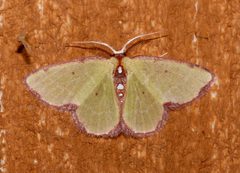
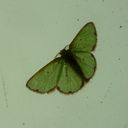
Synchlora cupedinaria is a small emerald moth in the Geometridae, first described by Augustus Radcliffe Grote in 1880. The is restricted to the Caribbean region and extreme southeastern United States, with confirmed records from Florida, the Bahamas, the Virgin Islands, Guadeloupe, and Martinique. Two are recognized: the nominate form and S. c. guadelupensis described by Herbulot in 1988. have a wingspan of approximately 14–17 mm. Like other members of the Synchlora, the larvae are known for their remarkable camouflage , adorning their bodies with fragments of plant material.
Pronunciation
How to pronounce Synchlora cupedinaria: /ˈsɪŋkloʊrə ˌkjuːpəˈdɪnəriə/
These audio files are automatically generated. While they are not always 100% accurate, they are a good starting point.
Identification
Synchlora cupedinaria can be distinguished from other Synchlora by its restricted Caribbean-southeastern U.S. distribution and specific wing pattern characteristics. The species is smaller than many with a wingspan of only 14–17 mm. The nominate S. c. cupedinaria occurs in Florida, the Bahamas, the Virgin Islands, and possibly St. Kitts and Puerto Rico, while S. c. guadelupensis is restricted to Guadeloupe and Martinique. Separation from the widespread S. aerata (Wavy-lined Emerald) in areas of potential overlap requires examination of genitalia or molecular markers; S. cupedinaria lacks the more extensive wavy transverse lines typical of S. aerata.
Images
Habitat
Coastal and insular in the Caribbean region and extreme southeastern Florida. Specific habitat associations are poorly documented, but related Synchlora occupy open, sunny areas with abundant herbaceous vegetation.
Distribution
Florida (USA), Bahamas, Virgin Islands, Guadeloupe, Martinique; possibly St. Kitts and Puerto Rico. The has a restricted Caribbean-southeastern U.S. distribution pattern.
Life Cycle
The presumably follows the typical geometrid with complete through , larva, pupa, and stages. Larval is inferred from related species: caterpillars are likely active during warmer months and use plant camouflage characteristic of the . Specific plants and voltinism are undocumented.
Behavior
Larvae of Synchlora , including presumably S. cupedinaria, exhibit a distinctive camouflage where they attach fragments of plant leaves, petals, or other vegetation to their bodies using silk. This behavior creates effective visual deception against . The caterpillars move with a characteristic looping or "measuring" gait typical of geometrid larvae, advancing by arching the body and bringing the hind forward to meet the thoracic legs.
Similar Taxa
- Synchlora aerata (Wavy-lined Emerald)Widespread eastern North American with similar larval camouflage ; larger size and more extensive wing markings distinguish it from S. cupedinaria
- Synchlora frondariaAnother southeastern U.S. emerald moth; requires genitalia examination for reliable separation
Sources and further reading
- BugGuide
- Wikipedia
- GBIF taxonomy match
- iNaturalist taxon
- NCBI Taxonomy
- Catalogue of Life
- Mystery of the frass revealed: Camouflaged looper, Synchlora aerata — Bug of the Week
- Plants as camouflage - who thought of it first? Meet the camouflaged looper, Synchlora aerate — Bug of the Week
- Geometridae | Beetles In The Bush
- Lepidoptera | Beetles In The Bush | Page 7
- October | 2012 | Beetles In The Bush
- Archive — Bug of the Week