
Nepytia canosaria
(Walker, [1863])
False Hemlock Looper Moth, false hemlock looper
Nepytia canosaria is a North American geometrid commonly known as the false hemlock looper. The occurs across a broad transcontinental range from northeastern Alberta to the Atlantic provinces, extending south through New England. are active in late summer, with records from August through September. The larval stage feeds primarily on conifers including balsam fir, eastern hemlock, and various spruce species.
Pronunciation
How to pronounce Nepytia canosaria: //nɛˈpɪtiə ˌkɑnəˈsɛərɪə//
These audio files are automatically generated. While they are not always 100% accurate, they are a good starting point.
Identification
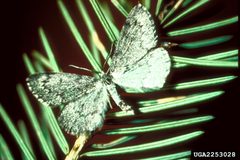
can be distinguished from the true hemlock looper (Lambdina fiscellaria) by wing pattern details and geographic overlap in some areas; N. canosaria tends to have more uniform grayish coloration with less contrasting markings. The name 'canosaria' (meaning 'hoary' or 'grayish-white') refers to this appearance. Larvae are separable from other conifer-feeding loopers by association and subtle morphological characters; identification to species often requires rearing to adult.
Images
Appearance
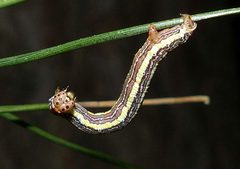
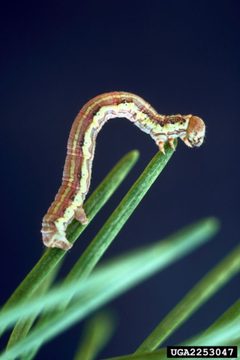
have a wingspan of approximately 30 mm. Wings are typically grayish-brown with fine, wavy transverse lines. The pattern includes darker discal spots and faint postmedial lines. The body is slender with a slightly tufted . are . Larvae are loopers (inchworms) with reduced , moving with characteristic looping gait.
Habitat
Coniferous and mixed forests; strongly associated with stands containing balsam fir, eastern hemlock, or spruce . Occurs from lowland forests to montane elevations. Larval is the foliage of conifers.
Distribution
Transcontinental in North America: from northeastern Alberta east through the Prairie Provinces to Ontario, Quebec, Nova Scotia, and Newfoundland; southward through New England (Vermont, New Hampshire, Maine, Massachusetts). Records also from Saskatchewan and Manitoba.
Seasonality
fly from August to September, with exact timing varying by latitude and local conditions. Single-brooded (). Larval stage occurs in spring through early summer, though specific timing of larval activity is less documented than for the N. janetae.
Diet
Larvae feed on foliage of balsam fir (Abies balsamea), eastern hemlock (Tsuga canadensis), and various spruce (Picea spp.). Occasionally recorded from other conifer species. do not feed.
Host Associations
- Abies balsamea - primary larval balsam fir
- Tsuga canadensis - primary larval eastern hemlock
- Picea spp. - primary larval spruces
Life Cycle
Complete with four stages: , larva, pupa, . (one per year). stage not explicitly documented in sources but likely egg or pupa given adult in late summer. Larvae are 'loopers' with reduced number, characteristic of Geometridae.
Ecological Role
Larval defoliator of coniferous trees. levels typically remain low without significant forest impact. Serves as prey for birds, , and other natural enemies. Role in nutrient cycling through herbivory and deposition.
Human Relevance
Minor forest pest; occasional localized defoliation reported but not known for large- unlike the N. janetae. The 'false hemlock looper' distinguishes it from the more economically significant true hemlock looper (Lambdina fiscellaria). No significant economic impact documented.
Similar Taxa
- Lambdina fiscellariaTrue hemlock looper; similar , conifer-feeding , and overlapping range; distinguished by wing pattern and larval
- Nepytia janetae with similar appearance and ; distinguished by geographic separation (southwestern U.S. montane forests vs. eastern and North America) and documented in N. janetae
- Nepytia phantasmaria with overlapping western range; distinguished by subtle wing pattern differences and
Sources and further reading
- BugGuide
- Wikipedia
- GBIF taxonomy match
- iNaturalist taxon
- NCBI Taxonomy
- Catalogue of Life
- Nepytia janetae - Entomology Today
- Nepytia janetae defoliation - Entomology Today
- Nepytia janetae Archives - Entomology Today
- Why Has This Moth Turned Into a (Sometimes) Destructive Forest Pest?
- Ann Lynch, Ph.D. - Entomology Today