
Nepytia
Hulst, 1896
false hemlock loopers, false pine loopers
Species Guides
11- Nepytia canosaria(False Hemlock Looper Moth)
- Nepytia freemani(Western False Hemlock Looper)
- Nepytia janetae
- Nepytia lagunata
- Nepytia janetae(Janeta's looper moth)
- Nepytia pellucidaria(false pine looper)
- Nepytia phantasmaria(phantom hemlock looper)
- Nepytia regulata
- Nepytia semiclusaria(southern nepytia)
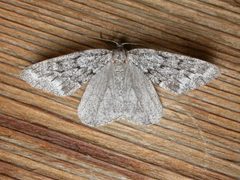
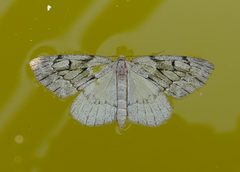
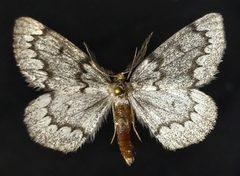
Nepytia is a of geometrid moths (loopers) in the Geometridae, established by George Duryea Hulst in 1896. The genus includes at least 13 described distributed in North America. Several species, notably N. janetae and N. freemani, have been documented as forest defoliators capable of that cause significant damage to coniferous trees. The genus exhibits considerable variation in traits, with some species being summer feeders and others, uniquely among studied Nepytia, feeding during autumn and winter at high elevations.
Pronunciation
How to pronounce Nepytia: //nɛˈpɪtiə//
These audio files are automatically generated. While they are not always 100% accurate, they are a good starting point.
Images
Habitat
Coniferous forests, particularly montane and high-elevation spruce-fir and mixed conifer zones. occupy diverse forest types across their ranges, with some associated with specific tree .
Distribution
North America. Documented occurrences include the southwestern United States (Arizona, New Mexico, Utah), with distribution records also from Vermont.
Seasonality
Varies by . Some species are active as larvae during summer months (May–July), while at least one species (N. janetae) exhibits autumn and winter larval feeding activity. of N. freemani appear in August.
Diet
Larvae feed on conifer needles. Documented include white fir (Abies concolor), Douglas-fir (Pseudotsuga menziesii), Engelmann spruce (Picea engelmannii), and corkbark fir (Abies lasiocarpa var. arizonica). Some are host while others are conifer . Starved larvae have been observed feeding on ground vegetation in forest understories.
Host Associations
- Abies concolor - primary Preferred of N. freemani
- Pseudotsuga menziesii - secondary Fed upon by N. freemani and N. janetae (New Mexico )
- Picea engelmannii - Primary for N. janetae in Arizona
- Abies lasiocarpa var. arizonica - Fed upon by N. janetae in Arizona
- Abies spp. - Fed upon by N. janetae in New Mexico
Life Cycle
(one-year ) in studied . N. freemani overwinters as , with larvae emerging in mid-May, feeding through summer, pupating in late July, and appearing in August. Females lay clusters of small oval eggs on both sides of needles. N. janetae has a 3-year eruptive cycle with autumn and winter larval feeding, which is atypical for the .
Behavior
Larvae are
Ecological Role
Defoliator of coniferous forests. can cause extensive tree defoliation and mortality. Population collapses have been attributed to , viral , starvation, and weather events including heavy rainfall during deposition. Tree mortality is associated with defoliation severity, moisture availability, and bark beetle activity. The serves as prey for and is subject to viral .
Human Relevance
Several are forest pests of economic and ecological concern. N. janetae has caused four major since 1996 in the southwestern U.S., defoliating tens of thousands of acres and causing near-complete tree mortality in some stands. N. freemani reached outbreak proportions in north-central Utah in 1965–1967. Climate change, particularly reduced snowpack, has been implicated in facilitating outbreak conditions, though mechanisms remain unclear.
Similar Taxa
- Lambdina fiscellaria (hemlock looper)Similar and ecological role as conifer defoliator; distinguished by and specific morphological features
- Other Geometridae loopersShared characteristics of looping locomotion; distinguished by associations, geographic range, and specific morphological traits
More Details
Species diversity and cryptic complexity
The comprises at least 13 described . Research on N. janetae suggests it may represent a complex of multiple species or , as in Arizona and New Mexico differ in larval coloration and specificity.
Research gaps
information is available for only a few . Most species remain poorly studied, and comprehensive understanding of the requires further investigation of basic , distribution, and .
Sources and further reading
- BugGuide
- Wikipedia
- GBIF taxonomy match
- iNaturalist taxon
- NCBI Taxonomy
- Catalogue of Life
- Nepytia janetae - Entomology Today
- Nepytia janetae defoliation - Entomology Today
- Nepytia janetae Archives - Entomology Today
- Why Has This Moth Turned Into a (Sometimes) Destructive Forest Pest?
- Ann Lynch, Ph.D. - Entomology Today
- ON THE OCCURRENCE AND BIOLOGY OF NEPYTIA FREEMANI (LEPIDOPTERA: GEOMETRIDAE) IN UTAH
- ACTIVITY RHYTHMS OF LEPIDOPTEROUS DEFOLIATORS: II. HALISIDOTA ARGENTATA PACK. (ARCTIIDAE), AND NEPYTIA PHANTASMARIA STKR. (GEOMETRIDAE)
- Seasonal life history and impact of Nepytia janetae (Lepidoptera: Geometridae): an emerging pest in Southwestern montane forests