
Macaria pustularia
(Guenée, 1857)
Lesser Maple Spanworm Moth
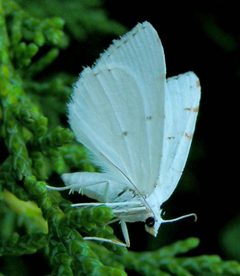
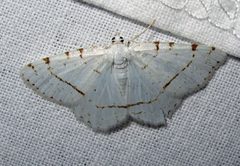
Macaria pustularia, commonly known as the Lesser Maple Spanworm , is a geometrid moth distributed across eastern and central North America. The species is well-documented with over 20,000 observations, indicating it is relatively common and conspicuous. are and attracted to light. The references its association with maple plants and the 'spanworm' habit of its larvae, which move with a looping gait characteristic of geometrid caterpillars.

Pronunciation
How to pronounce Macaria pustularia: /məˈkɛəriə pʌsˈtʃʊləriə/
These audio files are automatically generated. While they are not always 100% accurate, they are a good starting point.
Identification
Distinguished from similar Macaria by the combination of pale gray forewings with a relatively inconspicuous pattern and the presence of a small but distinct dark discal spot. Macaria bisignata (Red-headed Inchworm) has more contrasting dark bands and often reddish . Macaria notata (Notched Wing) shows more pronounced wing notching and different markings. Macaria adonis is generally darker with more uniform coloration. Dissection of genitalia may be required for definitive identification of worn specimens.
Images
Habitat
Deciduous forests and woodlands, particularly those containing maple . Also found in suburban and urban areas with mature hardwood trees, including parks and residential neighborhoods with established tree cover. Elevation range extends from sea level to approximately 1,500 meters.
Distribution
Eastern North America from Nova Scotia south to Florida, westward to Mississippi, and north to North Dakota and Saskatchewan. Core range encompasses the deciduous forest biome of eastern United States and southeastern Canada. Western range limits follow distribution of suitable plants.
Seasonality
fly from late April through August in most of range, with peak activity in May-June in northern areas and extended seasons southward. Two per year in southern portion of range; single generation in northern areas. stage is the pupa.
Diet
Larvae feed primarily on leaves of maple (Acer), including sugar maple (Acer saccharum), red maple (Acer rubrum), and silver maple (Acer saccharinum). Has also been recorded on other hardwoods including birch (Betula) and possibly alder (Alnus). do not feed.
Host Associations
- Acer saccharum - larval food plantsugar maple
- Acer rubrum - larval food plantred maple
- Acer saccharinum - larval food plantsilver maple
- Betula - larval food plantbirch , secondary
Life Cycle
Complete with four stages. laid on plant leaves. Larvae feed externally on foliage, progressing through five instars. Mature larvae drop to ground and pupate in soil or leaf litter. period lasts 2-3 weeks for summer , or several months for pupae. emerge to mate and oviposit.
Behavior
are and strongly attracted to artificial light sources, making them frequent visitors to porch lights and traps. Larvae are solitary feeders that move with characteristic 'inching' or 'spanning' locomotion due to reduced number of . When disturbed, larvae may drop from foliage on silk threads. Adults are relatively weak fliers and rarely travel far from plant stands.
Ecological Role
Larvae function as primary consumers, converting maple leaf to animal tissue. Moderate levels cause minimal tree damage; occasional localized may cause noticeable defoliation but rarely tree mortality. Serves as prey for various including birds, , and predatory insects. Contributes to nutrient cycling through deposition and eventual decomposition.
Human Relevance
Occasional minor pest in maple syrup production regions when larval densities are high, though economic impact is generally negligible. Frequently encountered by citizen scientists due to attraction to lights, contributing to its high observation count on platforms like iNaturalist. Used in ecological studies of forest Lepidoptera . No significant role in medicine or culture.
Similar Taxa
- Macaria bisignataSimilar size and but has more contrasting wing bands and often reddish ; larvae have different color pattern
- Macaria notataOverlapping range but shows distinct wing notching and more pronounced transverse lines
- Macaria adonisDarker, more uniform gray-brown coloration without distinct discal spot; prefers different
- Iridopsis defectariaSimilar pale gray appearance but has more angular wing margins and different pattern elements; in Geometridae but different
More Details
Taxonomic Note
The was transferred from Speranza to Macaria based on morphological and molecular phylogenetic studies. Some older literature may use the combination Speranza pustularia.
Population Status
Abundant and secure throughout range; no conservation concerns. High observation count reflects both genuine abundance and detection due to strong attraction to light.