
Macaria bisignata
Walker, 1866
Red-headed Inchworm Moth, redheaded inchworm
Macaria bisignata, the red-headed inchworm , is a North American geometrid moth distinguished by reddish-brown coloration and distinctive wing markings. are active from May to August across a broad range from eastern Canada to the southwestern United States. The is closely associated with pine forests, with larvae feeding primarily on white pine and related species.

Pronunciation
How to pronounce Macaria bisignata: /məˈkɛəriə bɪˌsɪɡˈneɪtə/
These audio files are automatically generated. While they are not always 100% accurate, they are a good starting point.
Identification
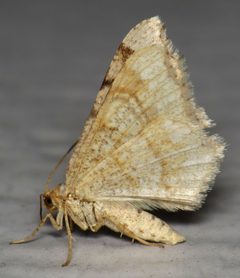
Distinguished from the very similar Psamatodes abydata by the presence of dark brown costal marks; P. abydata lacks these markings. The reddish-brown coloration is also a useful field mark. The combination of multiple dark costal spots and the subrectangular subterminal spot at the is diagnostic.
Images
Appearance
have a wingspan of approximately 25 mm. The is distinctly reddish-brown. Forewings display 3–4 dark brown marks where the antemedial, medial, and postmedial lines meet the (leading edge), plus a larger subrectangular dark spot where the subterminal band meets the costa. A smaller dark spot persists between M3 and CuA1 as another segment of the subterminal band. Ground color varies from light milky tan to darker gray-brown.
Habitat
Pine forests and woodlands, particularly those containing white pine and related Pinus . Occupies a range of forested environments across its broad geographic distribution.
Distribution
North America: Newfoundland to Georgia along the Atlantic coast, westward to Arizona, and north to Ontario. Present throughout eastern and central North America with western extensions into the southwestern United States.
Seasonality
on wing from May to August; exact timing varies by location and latitude. Single or multiple likely depending on geographic region.
Diet
Larvae feed almost exclusively on pine (Pinus), with Pinus strobus (eastern white pine) documented as a primary .
Host Associations
- Pinus strobus - larval food plantprimary
- Pinus - larval food plant-level association
Life Cycle
Complete with , larval, pupal, and stages. Larvae are inchworms (loopers) characteristic of Geometridae. Specific details beyond adult period not documented in available sources.
Behavior
are and attracted to light. Larvae move with characteristic looping gait of geometrid caterpillars.
Ecological Role
Larval stage functions as a herbivore on pine, contributing to nutrient cycling in coniferous forest . levels likely regulated by plant availability and natural enemies.
Human Relevance
Minor forestry interest as a pine-feeding ; not known as a significant pest. Used as a subject in ecological and taxonomic studies of North American Lepidoptera.
Similar Taxa
- Psamatodes abydataVery similar appearance; distinguished by absence of dark brown costal marks present in M. bisignata
More Details
Taxonomic history
Described by Francis Walker in 1866. Placed in Macaria, Ennominae, Geometridae.
Observation frequency
Well-represented in citizen science databases with over 9,000 iNaturalist observations, indicating it is frequently encountered and readily identifiable by knowledgeable observers.