
Macaria notata
(Linnaeus, 1758)
peacock moth
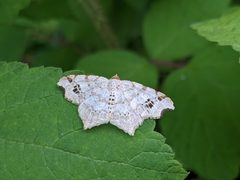
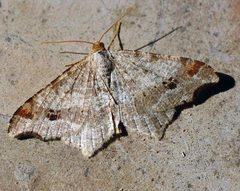
Macaria notata, the peacock , is a Holarctic geometrid moth with a distinctive wing pattern featuring a black spot resembling a paw print on the forewing. The is distributed across northern Eurasia and North America, where it inhabits deciduous forests and meadows. are active primarily from May to June, with two in central Europe. The caterpillars feed on leaves of deciduous trees including birch, oak, alder, poplar, and blackthorn.
Pronunciation
How to pronounce Macaria notata: //məˈkɛəriə noʊˈteɪtə//
These audio files are automatically generated. While they are not always 100% accurate, they are a good starting point.
Identification
The combination of the black paw-print-shaped spot on the forewing, the well-defined cut in the front half of the rear edge of the forewing, and the strongly pointed hindwing distinguishes M. notata from other Macaria except M. alternata. Certain identification requires examination of the genitalia. M. alternata is the most similar species and cannot be reliably separated by wing pattern alone.
Images
Habitat
Deciduous forests and meadows with thick brush, particularly areas rich in trees. Found in both natural woodland settings and semi-open with scattered trees.
Distribution
Holarctic. Palearctic: central and northern Europe, Russia, Transcaucasia, Iran, Issyk Kul, Russian Far East, Siberia, and Japan. Nearctic: south Canada, Washington, Idaho, Montana, Oregon, Colorado, Connecticut, North Carolina, West Virginia, Virginia, Tennessee, Georgia.
Seasonality
fly from May to June in the British Isles; two from May to September in central Europe. season varies across the range.
Diet
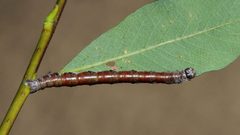
Caterpillars feed on leaves of deciduous trees: birch, oak, alder, poplar, and blackthorn.
Life Cycle
Complete with , larva, pupa, and stages. Two per year in central Europe; single generation in more northern parts of range.
Behavior
are attracted to light and can be commonly collected at light traps. activity pattern typical of geometrid moths.
Ecological Role
Herbivore as larva; contributes to nutrient cycling in deciduous forest through leaf consumption and subsequent decomposition.
Human Relevance
Subject of genomic research; sequenced from specimen collected at Wytham Woods, Berkshire, UK. Occasionally encountered by naturalists and enthusiasts due to its distinctive appearance and attraction to light.
Similar Taxa
- Macaria alternataExtremely similar wing pattern; distinguished reliably only by genitalia examination. Shares paw-print spot and wing shape characteristics.