
Isturgia
Hübner, [1823]
Species Guides
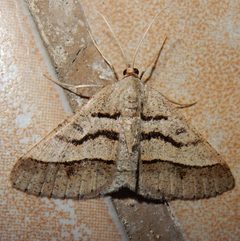
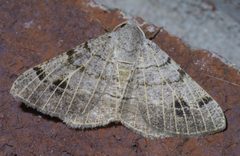
1- Isturgia dislocaria(pale-veined isturgia moth)
Isturgia is a of geometrid moths established by Jacob Hübner in 1823. The genus belongs to the Ennominae and contains distributed across Europe and parts of Asia. Several species have been studied for their and ecological roles, including one species (I. disputaria) investigated as a potential agent for acacia species. Taxonomic relationships within the genus remain incompletely resolved, particularly for such as I. limbaria/roraria.
Pronunciation
How to pronounce Isturgia: //ɪsˈtɜːrdʒiə//
These audio files are automatically generated. While they are not always 100% accurate, they are a good starting point.
Identification
Palpi hairy and extending beyond the . Hind tibia not dilated. Wings with evenly curved outer margin. Forewings of male usually with fovea. Venation: forewing 3 from angle of , veins 7-9 stalked from upper angle, vein 10 absent, vein 11 usually free; hindwing vein 3 from angle of cell. Male with very short branches in typical section.
Images
Habitat
associations vary by . Isturgia roraria is strictly associated with semi- habitats including forest clearings, forest edges, clear-cuts, and abandoned pastures, specifically linked to plant Cytisus scoparius. Isturgia disputaria occurs on Acacia nilotica trees.
Distribution
Europe and Asia. Specific records include: Denmark, Sweden, Germany, Italy (including I. sparsaria), Czech Republic (Czech Silesia, Bílé Karpaty Mts.), Poland, and Pakistan (I. disputaria). The I. limbaria/roraria complex shows western (north-western Italy, Germany) and eastern populations (northern and eastern Piedmont, north-eastern and south-eastern Germany).
Host Associations
- Cytisus scoparius - plantfor Isturgia roraria
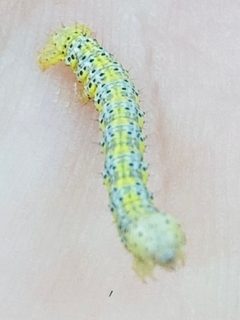
- Genista tinctoria - plantfor Isturgia sparsaria larvae in captivity
- Ulex europaeus - plantfor Isturgia sparsaria larvae in captivity
- Acacia nilotica - plantfor Isturgia disputaria
Human Relevance
Isturgia disputaria has been investigated as a potential agent for Acacia nilotica subsp. indica in Australia, though its on native A. nilotica in Pakistan raises concerns for local forestry. Isturgia roraria is considered endangered in parts of its range (Czech Republic, Poland).
Sources and further reading
- BugGuide
- Wikipedia
- GBIF taxonomy match
- iNaturalist taxon
- NCBI Taxonomy
- Catalogue of Life
- Observations on the Isturgia limbaria (Fabricius, 1775) / roraria (Fabricius, 1776) complex (Lepidoptera, Geometridae, Ennominae)
- The biology and preimaginal morphology of Italian endemic species Isturgia sparsaria (Hübner, 1809) (Lepidoptera, Geometridae)
- INFESTATION, GENETIC VARIATION ANALYSIS AND BIOLOGY STUDY OF BIOCONTROL AGENT ISTURGIA DISPUTARIA (GUENEES) ON ACACIA NILOTICA IN PAKISTAN
- Occurrence of Isturgia roraria (Geometridae, Lepidoptera) in Czech Silesia in the context of its distribution in Poland
- Figures 1–8 from: Rajaei H, Leipnitz M, Ortner S (2017) The biology and preimaginal morphology of Italian endemic species Isturgia sparsaria (Hübner, 1809) (Lepidoptera, Geometridae). Nota Lepidopterologica 40(1): 25-29. https://doi.org/10.3897/nl.40.10865